When you retire, you may want to visit the grandeur of Machu Picchu, the stunning beauty of Phuket, Thailand, or repose in one of the geo-thermal lagoons outside Reykjavik - I want to do that too, but first, Donna and I are taking in something of equal interest and esthetic: we're visiting baseball stadiums around the country.
When you watch the games on TV and the camera scans the stadium, you get a sense of the fans. Boston fans have the look of people that were subject to the business end of a Tazor, New York fans are constantly on their cell phones, St. Louis fans are engaged in the rhythm of the games in a knowing way, San Diego fans are happy and smiling (Is it possible to live in San Diego and be depressed?), Seattle fans look distracted as if they're trying to remember the last time they saw someone within the City limits who exceeded their body mass index. Baltimore fans tend to have jerky eyes, as if trying to follow the ball and not succeeding..
But some of the best fans though, seem to be in that Paris of the Plains, the City of Fountains, the Mecca of the Mid-West: Kansas City, Missouri. And go there we did: Red Sox versus the Royals. Kaufman Stadium in KC was constructed in the second half of last century. During that period, stadiums were poured concrete: it's a building material that oozes coldness, density, and a paucity of personality. When they get torn down, no one's going to buying a chunk of stadium concrete as a memento. If you have any doubt, I give you the baseball fields in Pittsburgh, Cincinnati, and Comiskey Park in Chicago as examples, but Kaufman's concrete must have been poured by people with good karma. The Park is friendly and impressive. The concrete smiles.
Red Sox lost and the game set a record for having three balks by pitchers - never been done before, but the KC fans made the game enjoyable with an air of good feelings.
They reward a good plate appearance with a cheer even if it's not productive. Good people, good barbeque.
The baseball fans in Boston, before the game, get their game faces on and fret about how the upcoming game might be lost. In KC as you can see from the picture above, it's a time to party. I do have a complaint though, but it's not directed just at the Royals. Baseball was always a game of leisure - the national pastime- where you could bring a book, take a cell call, and talk to those around you. Watching the game was one of many options. No more. From the lst inning to the last the air is filled with as much noise as a NASCAR event. PA announcements, loud music, overblown baseball commentary fills the air every second. If you go to a hockey, football, or basketball game, loud noise is part of the experience, but baseball was always a venue where we, the fans, make the noise, not them. I always liked going to the Durham Bulls games and listening to the triangle high tech guys or the Duke students sitting around me and planning exactly where they were going to vacation in the South of France or other places I couldn't afford. The conversations provided comity and a certain egalitarianism. Now I can't even yell at the umps. They can't hear me. It's like deciding to go vegan after you're dead. What's the point?
Leslie is pictured above. She was one of the Royals staff who covered our section. She did something I've never seen at any sporting event. She went up and down the steps asking people in our seating grid if they were enjoying the game and if she could help in anyway. She was magnanimous to everyone, even the guys on their fourth beer. The first time she approached me, I was suspicious and looked at her as if she was passing the church collection plate and was expecting me to top it off, but it turns out she was the real deal and just wanted Donna and I to enjoy the game. I finally responded with, "Get Gonzalez to hit a two-run homer in the 8th," and she good-naturedly said she would see what she could do. Leslie, you were worth the trip.
The next day we drove to downtown to see what we could see. The City is impressive. They built buildings downtown, maintained them, then left them alone. They did not second guess with renovations or re-development - no "Kansas City 2.0".
On our last day we were having breakfast at our hotel across from the stadium. As happens in the Mid-West, we started up a conversation with the next table, a couple from Tuscaloosa. Turns out the couple were there for the afternoon game even though the man said neither he nor his wife followed the Royals in particular or baseball in general. His wife left the restaurant, but he stayed and told us she was being honored in a ceremony before the game for her work in the community of Tuscaloosa.
That City had a deadly tornado the year before. Deadly. An 80 mile path and a width of a mile and 1/2, destroying the City and in the area encompassing surrounding towns, in four days, over 300 people died. The tornadoes did not ask for any financial statements of its recipients, but cut through the area structures like it was tearing through the federal income tax tables; from "0" worth to infinity. The destruction involved mansions and it involved shacks... and his wife was the city planner who had to help put the City back together again.
He told us she had been working 11 months without a day off and her work was gradually getting harder. Finding financing for the high end property was difficult but doable, for the marginal properties it was something else. He knew she liked to sew, and in the past would get together with other ladies that sewed... and talked about, well, sewing I guess. So six months ago, he started building a concrete block building the size of a small garage next to his house. Last month, she finally took a day off and he hung a sign above the door that said, "Sewing Shop" and she got to enjoying herself.
Nice Couple.
If you're expecting me to connect the 118 stitches on a baseball and the sewing shop and come up with something of significance, you're wrong. I'll leave that to the smart people.
But we can all think about it.
Wednesday, October 3, 2012
Monday, May 28, 2012
In Memoriam
This is the day, Memorial Day, to remember our war dead. For me that means a small group of people I served with in 1969-70 in Vietnam, but for you it may be another war in a different decade. My friends are frozen in time and place and the last part of their lives involved things like elephant grass, wait-a-minute vines, thump guns, LZs (landing zones), trip flares, puff the magic dragon, "don't mean nothing", and Victor Charlie - but their lives mean much more than that.
It is said as a cliche that our lives are like stones that are dropped in water and create a ripple that travels far beyond the original perimeters. But cliches become cliches because they are grounded in truth. We all exist and react to life in the moment, but our lives as a whole are permanently planted and nourished in time.
Several people have contacted me about their family members after my posts about "Treasure," "More Treasure," "Rest in Peace Doc", and "The Hurt Locker Hurts," I am grateful and feel privileged to connect with their memories. The fallen have left their measure in many lives long after they are gone.
Gone.
When I was riding my bike this morning on a green way path between two neighborhood developments, I was surrounded by tall trees that will bear witness throughout the day of people strolling, running, or like me, biking and enjoying the Memorial Day Holiday. Those gone before their time will never be able to experience those simple pleasures, or experience their first house payment, be filled with pride as their young child sprints to the school bus on the first day, embrace someone they love, receive the gift of an answered prayer, feel the joy of having a grandchild sit in their lap and give them a hug, know the curiosity and exhilaration of travel, and the thousand little things that life supplies. They will never feel the effects of Post-Combat Traumatic Stress Disorder because they never survived the combat.
For those I knew on the list, most very well, some very little, their lives ended in their twenties. You may have loved ones from a different time and a different war, but we are all connected, all of us, in our thoughts and prayers for them. They are in a better place now.
They mattered when they were alive.
They matter now.
My Friends:
William James Olson, age 21, Chicago, panel 10w-line 35
David Winder (Doc), age 21, Pennsylvania, panel 10w-line37
Wilmer Matson, age 20, Nebraska, panel 13w -line131
Rhea Kidd (Billy the Kid), age 26, Kentucky, panel 10w-line34
Van T Wray, age 21, North Carolina, panel 10w-line36
Arthur Munson, age 20, Colorado, panel 10w-line35
Albert Flores Tristan, age 21, Texas, panel 9w-line125
Richard Humphrey, age 20, Maryland, panel10w-line33
Curtis Ringhofer, age 25, Minnesota, panel 10w-line36
Raymond Souza, age 20, California, panel 10w-line 37
Monday, March 5, 2012
A Way
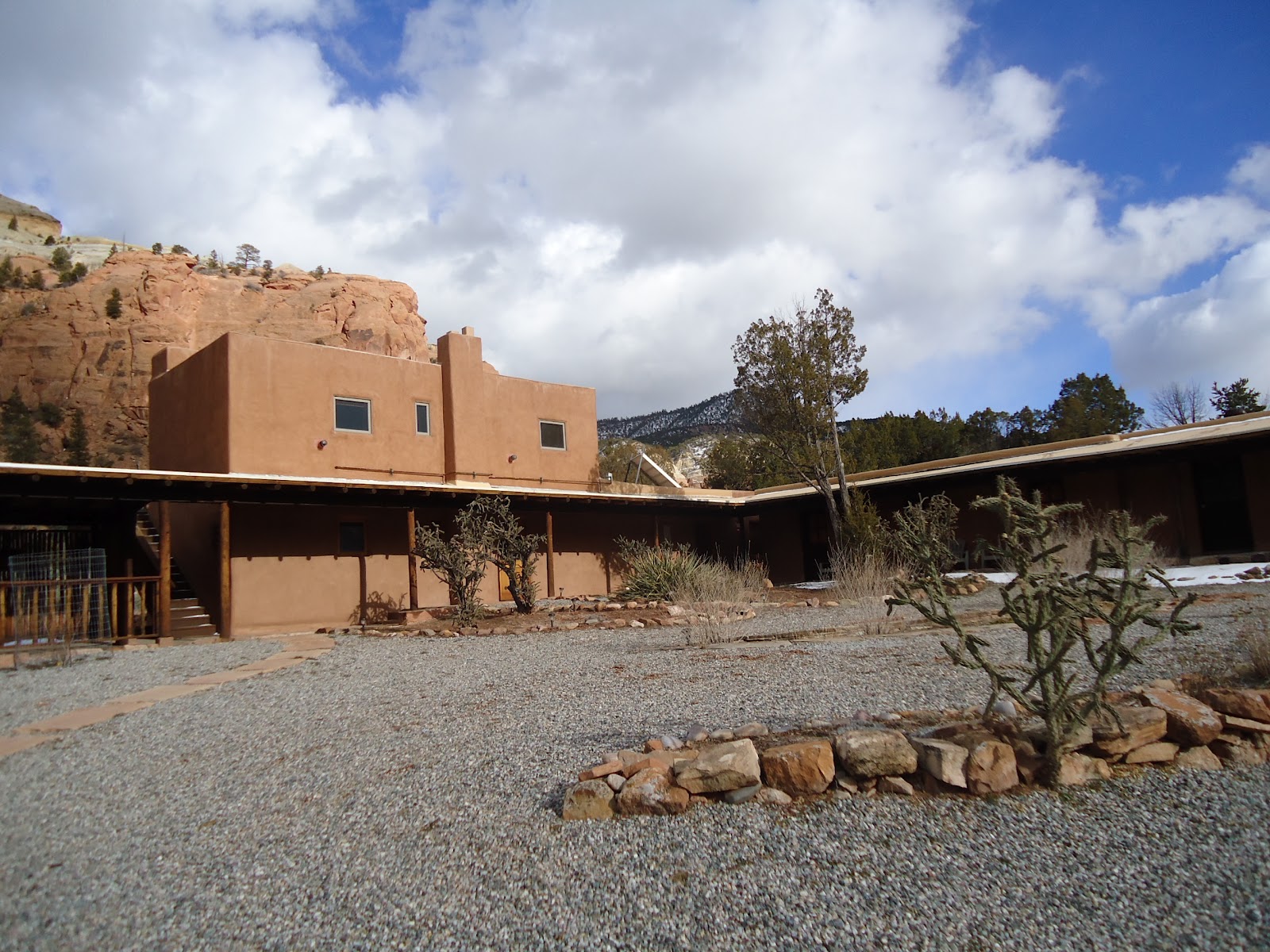
I just returned from a week at the Monastery of Christ in the Desert in the Northern mountains of New Mexico. The Monastery can be found at the end of a 13 mile dirt road in the middle of a national park in the Chama Canyon area - the home of painter Georgia O'Keefe. The area is a place of interest.
I visited 9 years ago and promised myself I would return every few years, but as we mark time, time marks us as well. As you enter the dirt road toward the Monastery, you are presented with a lot of western high desert. Look forward and you see color striated pinnacles that mimic the hoodoos of Zion National Park, drive through another turn of the road and there are folding hills, dot spotted with pinion pines that mother the unsteady sagebrush against the constant push of the wind. Take another moment to look up and you will see the resolute cliffs composed of red rocks as if transported from Sedona: the continuing play between the sun and clouds offer a visual scene of gratification - God's creation as a motion picture. Negotiate one more turn and you expect to find Gary Cooper riding a Palomino with six gun drawn looking for cattle rustlers, but what you will find instead are 23 Monks, dressed in black robes, praying and chanting to God.
These men have turned away from the world's conversations to dedicate their existence in total praise of God. Their days comprise living under the Rules of St. Benedict, public prayers of office that have periods ranging from 15 minutes to one hour, starting at 4am and ending at 7:30pm that involve chanting (150 Psalms a week); daily Mass; manual labor, individual prayer, and 3 meals. The Monks are self- sustaining and self-supporting : they receive no money from the Catholic church and would have to close down if the money ran out. They take a vow of silence, trying to make it "as common as talking is in the secular world." They make and sell craft items at stores in Chama and Santa Fe, provide room and board for guests like myself at $60.00 per night including meals (enough for 20 guests), accept donations, and brew beer (Monks' Ale: made with care and prayer) which I'm told is very good.. What can I say. Life's a conundrum.
The Monastery was started by three Monks from New York in 1964. The Monks now range in age from 20 to 90 years old and come from many countries. Their mission is to pray for the world and give praise to God through the chanting of the Psalms - period. My understanding is that they do not leave the Monastery to evangelize, but do so by creating "...a sanctuary where both Monks and retreatants, Christians, believers in other faiths and those with no religious beliefs at all may experience something of that peace which the world cannot give..." They do. If I was asked to describe them in one word I couldn't - it would take two: happy and content.
(my room)
Usually my mind resembles the "scan" button on the car radio. Constant unrelated thoughts pinging against each other much like a cue ball in a game of pool between two teenagers after imbibing in umpteen energy drinks, that's me. So you imagine I'm not the best candidate for contemplative prayer, but the Benedictines don't go college on you. It's very basic and I only had to be in the church for one minute of chanting and praying on the first day to realize the specialness and good of it.
The first time I was there I was curious and just wanted to dope it all out, participate, then leave, but like anything else, with practice, God let's us see lower layers of ourselves. Through Him we realize there's more to us than we thought and more of Him in us than we thought. I've been back in North Carolina two days and find myself missing aspects of my visit already. They should have no worries though, there will be no "Brother Grumpy" in the future; I'm not cut out for that life ( "What, fish stew again! We had it last week!") and guess most are not either. But I take comfort in the fact that there are people in a wilderness worshiping God without interruption for a world they will never experience.
(guesthouse)
One word about the "silence" that seems to grab everyone's 'attention. There are places where you can converse with one of the Brothers if you have questions, it's no big deal. They will also readily break their vow if you need an answer on something important - they also took a vow of love that supersedes the silence. There are no creature comforts: no TV, electricity, internet, or cell phone reception. All good. I had a 5 hours layover in DFW Airport on the way back and assiduously stayed away from the hanging TVs in the terminals, I did not want to "catch up" and now that I'm home, sorry I have.
One more thing. I was there with a Methodist Minister and Presbyterian Minister last week. For a good part of the stay I was the only Catholic there. In a common area, Brother Andre asked me where I lived and I told him Raleigh, NC. He pointed out that two groups come every year from Duke Chapel and the Divinity School and mentioned their largest group was coming in April, a Southern Baptist divinity college in Waco. Point being, you don't have to be Catholic. Martin Luther is probably on his way there right now.
(Common Room)
"Be Still and Know that I am God" Psalm 46.
Sunday, January 29, 2012
A Purpose Driven Life
(courtesy - Google Images)
As I wrote in a previous post, my son Adam is in the US Coast Guard and is stationed at Point Allerton, a small boat station in Hull, Massachusetts just south of Boston. It is a noted Coast Guard Station because it is the oldest and it is the oldest because it was the first - founded by an extraordinary man named Joshua James - the father of the US Coast Guard.
He established himself as a "Lifesaving Station Keeper", at age 62: a given age, when time adjusted to the 19th century, would be well past retirement today. He formed a crew of 7 and then set about saving over 1,000 people in sea rescues: no one had done that before. The historical record on him is sketchy and I relied on internet sources and can only hope they are accurate, but there is enough about him from multiple sources to ascertain certain basic facts about his life:
-He lived from 1826 to 1902, 75 years. He was born in Hull, Massachusetts, 9th of 12 children.
-He was a Lutheran who, like his father, read the Bible every day and was a Sunday school teacher.
-He participated in his first sea rescue at age 15 and became an accomplished sailor in the waters around Hull and the islands of Boston.
-He entered the maritime shipping business and became successful through gumption and frugality.
- He once owned 25 schooners and contracted with the City of Boston to provide most of the cobblestones for its downtown streets.
He gave each of his sons a schooner when they turned 25 and also had them participate in rescues.
-He was humble. On his application for the Hull station, he merely wrote, "fisherman" next to his name.
-He died at 75 years, after completing a life boat drill.
-He died poor. A collection had to be made for his family.
As an aside, I have mixed feelings about those cobblestones. Like many older cities, Boston maintained those type of streets well into the 1950s. On our infrequent family jaunts into Boston when I was under 10, I remember negotiating the cobblestone crosswalks with difficulty. The stones provided a certain rough consistency for transport, but not comfort. These were not the smooth pavers on display at Home Depot, but thousands of buried stones angled and rounded in the expanse between buildings, each stone with its own unique rounding. Back then, the thoughts of a small boy did not carry any concern for adult women in high heels trying to maintain a dignified gait through those same crosswalks, but I wince when I think of it now.
( courtesy google images-Beacon Hill, Boston)
I'm not much on facial analysis, but when I look at his picture, I see resolution. He looks focused in the picture, full of determination. I think trying to explain the concept of "downtime" to him would be a long conversation. I'll bet he could stare down a block of New Hampshire granite. Some people are like that.
But why would a successful businessman stop what he was doing and endeavor on a new path for little or no recompense?
The answer is said to be a family tragedy that occurred when he was 11 years old. His mother and young sister were returning from Boston on a schooner and a sudden squall hit while they were approaching the Hull Cut, 1/2 mile from safe harbor. The boat went down and them with it and the internet sources indicate he witnessed the event.
Or was it ego? Did he just want to go nine rounds against mother nature without meeting the canvas?
This is just speculation, but my observation is that ego centered actions are short-lived and Joshua James was not a road flare, but a long burning candle. The rescue numbers bear that out. I'm sure some rescues were easy, like a nautical beer run over a light chop, but most, by definition, were not. Ships falter in bad weather. An example is the Hurricane of 1888. He and his crew put oars down during the storm to rescue an imperiled crew. They rowed for almost an hour, then hit rocks, turned around, rowed back, got another lifeboat, rowed back out, saved four out of seven sailors, then rowed back to safety - against the worst sea the hurricane could present. In 36 hours, they rescued 29 people off 6 wrecks...without sleep.
We may not know his motivations, but we know his actions and those actions open up his window and when we look in, again, I don't think we see ego but something else. When catastrophe happens in our lives it affects us, it molds us. He could take his tragic events of his mother's death and fold his emotions into themselves; turn inward; call it "God's will" and get on with his business. Or take those events to a certain purpose. Perhaps James found that in life, the answer to his petitions in prayer were not the petitions themselves, but the answer was God. Perhaps by trying unselfishly to alleviate the burdens of others that life sometimes provides, he and his crew turned their own lives into a prayer - a form of worship.
I believe when we end this life we start another with God. Perhaps to get there some will take a non-stop flight, others will connect with varying layover times, but we'll get there. Or perhaps our means of transport will be in another form....a crew of 7, Joshua James at the tiller. You never know.
-----------
July 30th every year is designated "Joshua James Day" with members of the Point Allerton Station presenting the colors at his grave on a hill overlooking the harbor; that night 1,000 flares necklace the bay in celebration and memoria. His legacy labors in obscurity - I grew up in the area and never heard of him so I hope this posting helps. Our son Adam is last on the right in the ceremony below.
One thousand candles...One thousand lives.
-.
Wednesday, December 28, 2011
Wretched Excess 2011-2012 Edition
Behold the new $3.5 million dollar NC State Chancellor's mansion just opened this month. It is so big, it has a name, The Point. The Point backs up to Lake Raleigh on one side and expansive landscaping that increases the mansion's sweep on the other: better to be even more isolated.
I suppose we should be grateful that construction jobs were created during the process, but the taxpayer's foot the bill (as usual). Enjoy the digs, Mr. Chancellor.
Tuesday, December 13, 2011
Ending 2011
Do You Have Anything For Me?
Recently, Lucas, our next door neighbor, came up to Donna as she was getting out of the car, smiled and asked, "Do you have anything for me?" He is 4 years old and at that age his thoughts originate in his head and take a non-stop flight to the public runway without the benefit of any air traffic control. God encourages us to be like children and I think this is what He has in mind; total honesty and truth without any cultural or behavioral circumventions. In other words, people should try not to act like adults.
I don't know why Lucas said what he said since our meetings with him do not usually end in a gift presentation, but it was on his mind and he probably thought it would be a nice question to ask. Since he is one of the smartest people I know, it got me to thinking. Why not have a "Do You Have anything For Me" day? We could spend one day a year posing that question to those around us, receiving and then giving a compliment (and only compliments) to those we ask.
Unlike April Fool's Day, we would get some positive reinforcement. Most of us go through life without any structured encouragement so this could be a feel good day as well as an educational one. You get to learn something about yourself..."Me? You think I'm a good parent? Really?" Just a thought. As always, thank you Lucas!
Best Travel Tips of 2011: Innocents Abroad
On Thanksgiving morning, Donna and I met a dear old friend at the airport. She is a former airline employee who has visited over 82 countries and travels alone. Her husband, Jay, has culinary tastes that exist within a very small range and is so finicky he will only travel to places he can get a hamburger/meat and potatoes prepared to his liking. He's not going to be trying out the Malabar cuisine in Riyadh's newest restaurant anytime soon; so his travel tolerance eliminates most foreign countries, and come to think of it, a good chunk of the US.
I asked her how she handles traveling alone since some of those 82 countries involve the third world and/or countries with high crime rates. She told me she has 3 rules she always follows. I'm sure these rules have been mentioned in one form or another in travel publications like Conde Nast and Travel and Leisure magazine, but they bear repeating.
- Dress like a bum - be sure you wear colors that don't match, fabric of poor quality, and design patterns that clash. She buys most of her travel clothes at thrift shops i.e., foreign thrift shops. She regards luggage as an unnecessary encumbrance and puts a change of personals and feminine particulars in her purse. That's it.
- Shave your head - it makes you look odd and unapproachable.
- Don't initiate any conversations - and she has found people on the plane usually keep their distance.
Happy Trails To You
Best Dog Day of The Year
One day we took our son's dog, Bruno, with us to visit Donna's stepmother at the local assisted living facility during their lunchtime. We walked into the expansive dining hall that contained about 30 tables, 4 residents per table. Most residents ambulate with the assistance of aluminum walkers that have two tennis balls affixed to the rear legs.
Bruno had a blast.
Worst Dog Day of The Year
In September when we were up in Boston visiting our son, Donna received the following text on her phone from Sam and Jane who were dog sitting Bruno for us
-----------------------------------------------------------------------------------------------
Sam Felner, Friday Sept 30, 1:32pm
Elias just peed on Bruno.
No, Elias is a 2 year old boy.
Best Book I Read in 2011
Unbroken: A World War II Story of Survival, Resilience, and Redemption, by Laura Hillenbrand. An inspiring story of someone whose life can barely be contained between the book's covers. He embodies the American spirit; he is what this country used to be about and will be again. Ms. Hillenbrand also is an interesting story herself. If you get time...
Best Movies I Saw in 2011
Not a good year for cinema verite. Can you think of one good apocalyptic zombie movie this year? Just one? Me either.
Poirot: Murder on the Orient Express - Yes, a familiar story, but the ending is terrific. Poirot (David Suchet) is holding a rosary, agonizing about the reconciliation of justice and mercy.
Fracture - Guy kills his wife. Anthony Hopkins. What else do you need to know.
500 Days of Summer - Ok, a superficial chick flick. I liked it. Don't tell anybody.
(Google Images)
Wishing You All a Very Happy and Holy Christmas and an Outstanding 2012!
Tuesday, November 15, 2011
Bad Day At Black Rock
I hate this. You could put your time to better use if you read something else besides this post. If you google , "Steve Jobs eulogy", a eulogy given by his sister the author Mona Simpson, you will be reading words filled with heart and soul. We should all have a sister like that.
Since I'm not taking my own advice, I will try not to make this too much like a whining screed. Several weeks ago I visited the new Martin Luther King Memorial, dedicated last month in Washington DC at a cost of 120 million dollars. It was a clear day, bracing temperature, the sky blue with occasional white clouds wafting and providing enjoyment to the morning. The air was full of autumn; God did good.
I had a flawless 45 minute flight from RDU's new terminal to National Airport, a pleasant ride free of turbulence. I then boarded Washington's premier "Metro" rapid transit and exited at the Mall. The Metro is a study in simplicity and accomplished architecture that has underground station stops of high design interest; filled with walls of continuous concrete, honeycombed patterns that on occasion make a rider feel they are in the last reel of a James Bond movie. I must say though that in all my years I have never seen anyone actually talk to someone else during the ride, but that's a big city for you.
I exited the Metro and proceeded west toward the Tidal Basin and walk I did. I knew the King Memorial was across from the Jefferson Memorial, but I could only see the continuous treeline that hugged the water. "Keep going, you can't miss it, " was what everyone told me, but I almost walked past it and would have, except for a very modest sign by the parkway. There, among the trees was a large block statute, about 2 1/2 stories tall, of Martin Luther King. The overall setting reminded me more of Joyce Kilmer than MLK.
The Memorial is an elegant and simple affair. As you can see from the photo above, a large stone block protrudes from the middle of a stone mountain. This is an allusion to a line from his "I Have a Dream Speech", but you wouldn't know that because the Memorial doesn't provide the speech in any form. The block is back grounded with one or two sentence quotations of mixed remembrance on a wall that resembles a breaking wave, curling away from the block in descending height: that's it. I'm sure the designers are sensitive about "disney-fying" the structure, but surely in this age of mult-media, Dr. King's "Letter from a Birmingham Jail and the "I Have a Dream" speech, among others, could be somehow displayed.
There wasn't another park ranger tour for another 2 1/2 hours so I asked the nearby landscaping crew why it wasn't larger. They laughed and said I was the only person to complain about the size - they all thought it was fine and that it appears larger at night with light shadows washing over the Dr. King's chiseled profile and the nearby trees. The crew was quite happy with the Memorial: I was not - so you see my opinion on this may not be universal.
If you think of the great leader monuments at the Mall, the Washington Monument and the Jefferson and Lincoln Memorials, Dr. King should have had a place as grand and elevated as them - and he doesn't. If you consider their longevity on the country's main stage: 8 years of Washington to clear the path for political primogeniture, 10 or so years for Jefferson to imprint democracy's concepts through the Federalist Papers (with help from John Jay and James Madison) and the Declaration of Independence, and only 3 years of Lincoln, our greatest president, Dr. King was on that public stage from 1955 through 1968, a full 13 years. He was not just a leader of an ethnic group , not just an advocate of group civil rights, but one who held up a mirror to the country and asked us to live up to what we can be, live up to our words, become America and everything that it embodies - we're better than this - he urged us on and made the country better. We inched closer to our true beliefs.
Dr. King held up that mirror to us for 13 years and he never put it down. He held it with a firm grip, unwavering, confrontational even, but always with love, always with God. Dr. King said that "any law that uplifts human personality is just. Any law that degrades human personality is unjust." That is why his Memorial should be just as grand in size and scope as the others, that is why Dr. King's legacy is so important. Calling him a leader of the "civil rights" movement seems limiting and rigid because he was more, he was a leader of the country.
As I left to head back to the airport, I passed the WWII Memorial. It too is hidden in the trees. Apparently sight lines and landscaping concerns over rode our remembering the country's role in that War. When funds were being raised for the Memorial, I wondered how the designers could encapsulate the scope, the bravery, the horror, the gravitas , and the country's determination to win. The answer was they didn't; I don't think they tried. You could walk past the Memorial without noticing and I feel bad for someone who comes from any distance to see a circular sea of granite with engravings of battles on it. It looks like a structure designed by a homeowners' association.
Currently we don't live in an age of giants so I guess it is not surprising we create memorials that are lacking. Dr. King, Jefferson, Washington, and Lincoln put the nation's welfare above themselves, their wants and ideology. Today our political leaders seem seek their own accommodation. I'm enough of a realist to write that last sentence, but I also believe that others will come - a future Lincoln or Washington.
Perhaps one of the young people who come to see Dr. King.
Subscribe to:
Posts (Atom)