Wednesday, October 12, 2011

Miles of Tiles: Gridlock and God

Two months ago I went up to Boston to help my son get settled in the Coast Guard. One day we found ourselves driving in the Winter Hill section of Somerville just north of Boston.  The area is a magnet for young sophisticates, college students, the newly married, and by people overloaded with duende and cool...in other words people not like me. The narrow streets off Davis Square that we were driving were closely shouldered by a mix of older, single, and multifamily homes. The homes were mostly an off- shoot of the "Irish Battleship" structures...three deckers,  three stacked shotgun houses similar to those in the Garden district of New Orleans, except with porches.  They were old and honest and for the most part met the sidewalk without the benefit of grass.

At one intersection I looked to my right and just past the chain link fence saw a statute of Mary holding Jesus. The statute was at one end of the small plot, looking outward.  It appeared that Mary had suffered quite a few New England winters so that her alabaster halo and soft, blue coating had faded. The size and placement of Mary showed no theological narcissism by the homeowner, no tub thumping evangelism. I like to believe that someone put the statute there so that during our busy day, we could, if we wanted,  take a minute of worship and reflection.  I delighted at this and  hoped that delight pleased God.  Surprises like that are what I miss about Boston.

I now live in the Bible belt in North Carolina, so worship is no stranger to the area, but many Southerners (and Northern transplants) also worship procedure and propriety and in the PUD (planned unit development) administrated by the HOA (Homeowners' Association), where I live, Mary would be subjected to a "mother may I" neighborhood meeting  which would define the outer boundaries of patience and be subject to all the regulations of any lawn ornament. It's too bad - that tendency makes us smaller. As Mark Twain said, it's "good in the worst sense of the word", and we don't always realize it.


                                                                                               (google image)

Two weeks ago Donna and I went back up to Boston to visit.  I had never paid much attention to the depressing of the Central artery. Officially called the "Central Artery/Tunnel Project", the Big Dig encompassed transforming  an elevated highway  into a tunnel,  freeing the ground space; a southern approach tunnel to the airport, and a northern collection of s-turns, off-ramps, and a warren of signage enough to confuse a NASA satellite. I won't go into the project itself; budgeted at 2 billion dollars, came in at 23 billion dollars - says it all. Supposed to be completed in 1998, completed in 2006 - says it all.

Boston is an elegant city with a sense of history and deserved better.  Prior to the Big Dig, the Artery looked like the result of Boston challenging Portland to a knife fight, losing, then being left with a jagged edged, swollen scar that ran across its entire face. The project would bury that loss, improve traffic gridlock,  and join the Italian North End with the city's downtown and the financial district.

But at what cost?

In the past when driving the Artery in gridlock, the traffic moved with all the speed of lava flowing uphill, I would look out beyond the guardrails of the elevated road and see the magnificence of the Rowe's Wharf building and the large corner clock, slouching atop the South Station train station. The clock was broken from the mid-sixties to the late seventies (Was time too expensive during those 15 or so years?  Or too insignificant?)  I would gaze at the Boston Federal Reserve building that was tagged "the Venetian Blind" and it addressed the street at such an odd angle that you would think its front side had changed street location every night.   It was also nice to look at the lonely rooftop apartment in the financial district, one side glass walled with palm fronds. I fantasized the renter was a Left Bank artisan from Paris who moved to Boston for better light. These were pleasant and distracting thoughts as the on-ramp car next to me was forced to cant so close that the car's driver side mirror was trying to sexually force its attentions on my  passenger mirror.  No fun that.

Two weeks ago when Donna, Adam, and I used the tunnel to go through the city, the traffic flowed very smoothly (I'm no fool, I didn't test it in commuter hours), but I wonder if I was wrong in my previous post about the Joni Mitchell song.  Perhaps something is lost when something is gained.  Years from now, the gridlock will reemerge and if we ask a tunnel tile what color it is, it will plead the 5th Amendment.  And there will be no sense of the City, no broken clocks, no rooftop apartments, no statutes of Mary.... just....


...miles of tiles..

Monday, September 12, 2011

Retirement for Dummies


"Retire - verb: to withdraw or remove oneself."

Life is passing me by and I couldn't be happier.  Well maybe.  I stopped working in mid-June.  You could say I've retired, but you never know what the future will bring.  Since June, I've spent time helping my son Adam set up his living arrangements/car at his first coast guard duty station south of Boston, then another surgery in July on my ankle, so I haven't quite crossed over into retirement geezerhood, but I'm getting there.  I was initially surprised at people's reactions when I told them I was retired.  They all said the same thing, "Congratulations!"  That seems appropriate, but also not quite appropriate at the same time.  I think us retirees become a cipher of envy for those still working..."if only", much like the response John Steinbeck in Travels with Charley was greeted with when he told people he was traversing the country in 1960 in a custom made camper with his dog..."if only". Something everyone wants to do.

Close to retirement, I questioned men who had already retired (I did not ask any women as they still remain a mystery to me - besides, they never really stop working).  Most men can engage in easy conversation about sports, work, and households (the structures not the people), but shy away from talk of marriage (love),  musings on the theological or moral (beliefs), personal finance (security) - in other words, we can talk about the least important things and keep silent on life's most important things. The subject of retirement though is an exception.  I've found that men are very open and honest in assessing this period of their lives - maybe it's because they now have the time?

"Retiring is the worst decision I've ever made in my life."
"I can't believe I waited so long.  I don't have time to work if I wanted to."
"The moments are hard to fill sometimes."
"Best decision I ever made."
"I'm still finding my way."

The last one is me, but I think that is an element at the beginning of the retirement phase of life. I wish there was a retirement orientation and it had a process like Elizabeth Kubler-Ross's five stages of death (denial, anger, bargaining, depression, and acceptance)...I said like. but there isn't.  Surprisingly, the people I've found that are the most successful in retirement are the "type A" people.  the ones we all prognosticate will be dead six months after they leave the workforce.  They tend to do very well.  Being type A's, they find retirement tasks and then dedicate themselves to those tasks wholeheartedly, just like they did at work; or they learn forthwith that leisure has no place in their life and they go back to work.  their journey seems quick  It's the rest of us who have to hike over unknown, uneven ground without an internal compass or watch. 

So what have I learned so far?

Without any purpose, the days bleed into each other.  There is no weekend because there are no weekdays - and all have the potential of wasted time.  To correct that I've now decided to force some habits.  No daytime TV, even sports.  No internet more than one hour a day;  email, banking and investments, web searches, and favorite sites have to be done within that hour.  In the past, the paths of  my internet searches resemble that saying about economic forecasts (if you put them end to end around the world, they would all point in a different direction) so as the kids say, it's a big "time suck."

Another practice is setting a schedule 6 days a week to do one task only for a set amount of time.  In the mornings I've started to write - for someone else it can be something else.  Writing is thinking with words and it helps me dope out things in life.  I'm doing that now with this issue.  So in a sense, with the implementation of a  schedule... I'm going back to work!

Other goals?  I don't want to learn anymore.  I want to experience.  It has taken me along time to realize wisdom is better than intelligence.  I once spoke with a senior who spent a winter in Ixtapa-Zihuantanejo, Mexico studying ancient ruins and living in a hut with a dirt floor.  She exuded excitement and joy when describing the senior hostel experience and I could tell it was a significant journey in her life though I have no desire to follow her lead.  I want to travel, yes, but not to learn by collating data.  I really admire her passion about the trip and she reminded me of what a Wall Street Journal sportswriter wrote about a particular player...he played with all the intensity of a Johnny Unitas after a sausage breakfast." So maybe after all she experienced as well as studied. But I single mindedly  want to experience things...I want to experience God, not listen to a 45 minute sermon on Him no matter how good.  I want to listen to the downbeat of a Duke Ellington piece; not look at the sheet music.  Joanie Mitchell may have gotten it wrong in the song Both Sides Now, something may be gained when something is lost. I want to fill my heart, not my head.

Two other things I will need to work on as I get older.  I think it was Joan Didion in The year of Magical Thinking, that after she lost her husband there was not quite the need to measure and check the angles of life, no need to apply a moral tape measure to actions - both her actions and others.  I need to remind myself that life doesn't need my post game analysis.

Lastly, I need to guard against the encroaching ailments of old age.  We will  grow to frailty.  I've had some short periods of disability and know that illness can tinge thinking and outlook.  Jan Morris, a transsexual and wise man, wrote a book chronicling his life,  Conundrum.  He was born a man, was a famed London Times correspondent who was part of the first  expedition that successfully scaled Mount Everest in 1953.  He married, had children, had a sex change operation when he was 58, divorced his wife and then at 81 years of age, had a ceremony of civil union with the same wife (I wonder who got the bridal shower?).  Anyway, he/she was a keen observer of the human condition and from his unique male viewpoint said that as he aged, one of the worst developments he experienced was the loss of physical stamina and strength and how it affected his thinking and attitude..  He thought that this change was much more prominent in men than women.

We'll see

.

Monday, August 22, 2011

Love on the Rock

Why is it that the strongest, most important emotions we have cannot be defined? What is love exactly - in any form or content? Why is it that we cannot get a rope around it? If you look up the word"love" in the dictionary you find "affection", look up "affection" and you will find "love". Love directs and guides our lives with more force and purpose than anything else. Without it, we would just live in a series of random moments.

Our world shies away from the spiritual and ethereal. We live within measures. I love on a street whose length is 1/4 miles with 33 structures comprised of various square footage. The people in those structures are of varying ages, computed in day, weeks, and years and have seniority numerics in school, work, wedding and time on earth. Tomorrow isn't just Wednesday, it is the 17th day of August (8th month) of 2011. When I go to the surgeon tomorrow he will ask me to number my pain level from 1 to 10. the weather tomorrow is forecast to be a high of 91 and low of 69 with 10% chance of rain and a 7mph wind. We live in a world of numbers that quantify and measure. When I die I'll still have a number - my blood pressure will read 0/0. Why is there no number on love?

Nothing wrong with that in particular since the numbers only provide description and crude valuation. Keeping a mileage log of a journey does not describe the journey's purpose, knowledge gained and knowledge reflected upon. The important stuff. I'm stumped - and when I'm stumped, I go see my consigliare, Lucas Holder, my next door neighbor, age 3.


Grumpy: Luke, can you give me a working definition of "love"?
Lucas: Mr. Grumpy, pay attention, I don't have a lot of time and I don't like to repeat myself. See the triangle I've made with my hands?
Grumpy: Got it.
Lucas: In the art world we call this the theory of negative space. the triangle doesn't exist per se, but is defined by the positive space that surrounds it. In other words, the space, in this case, the love, has an essence that is mysterious and cannot be known by degree. We can only glimpse at its true nature from what surrounds it; i.e., agape love, common courtesy, charity, familial love, kindness, friendship, and maybe even romantic love. What the "it" is , well that's the mystery.
Grumpy: You're saying that the nature of love is unknowable?
Lucas: Perfecto.
Grumpy: So even if we don't know what love is, can we find out where it comes from? That may give us a clue.
Lucas: Mr. Grumpy, I don't know everything. I'm only 3 years old.
Grumpy: Thank you Luke. You've helped me and I am going to give your mother and father a check to help pay for your first year at Duke University.
Lucas: Forget the money - just help me fill up my water pistol.
Grumpy: Cool. And could you explain Occam's razor to me again?
Lucas: I'm busy through the end of the week. See me on Monday.

So I think Lucas has something. I began asking people what they love (women mostly, guys don't ask each other questions like that) and was surprised by the uniformity of answers. They revolved around family - past and present, but most answers came from the younger years. I guess when we are older we appreciate - we view things with perspective and from an analytical viewpoint and when we look at things with ten or twelve year old eyes, we realize and live in the world of the new. Life's new car smell is still present. We experience simply, innocently, and completely and think that life comes with safety bumpers and those bumpers will protect us so there is no questioning or limiting our acceptance of love. I expected that when asked what their first love was; girls would mention their first boyfriend; guys, their first car. Some did and those answers may reflect more commonality than you think.

If asked about what I loved most in my youth, I would mention Cape Cod. Sand and beach? Really? Yes, really. Our family used to spend two weeks' vacation at my Grandparents' modest summer cottage in Harwichport. I remember long days at the beach with my sister and parents - waking up early and running down to the beach on a road filled with pine cones and sand that tickled my feet as I ran; then foregoing the wooden steps leading from the top of the sand dune to the beach and doing a buck and roll off the top dune down a steep vertical slope, legs straight, hands fitted against my hips, eyes straight ahead as if perusing my pirate kingdom, but also wondering if the sand will bury me as I rapidly descend to the beach. I remember hoping that a pirate still maintains a center fielder's arm so that I could find and throw a flat stone that would skip all the way across the far horizon. I remember watching the still ocean water ending up on the beach as if surprised by its own forward motion; taking its last breath with a gentle whoosh, a watery whisper. I still remember to this day that sound and smell of salt. I remember suffering my mother's application of a 1950's sunscreen that had the viscosity of 30 weight engine oil with more secure bonding to the skin than construction bolts to a skyscraper's steel girder - re-applied every hour. I remember nights filled with board and card games, reading, and Drive In movies with a stop at the ice cream stand. I remember the cottage fireplace full of driftwood on a cool evening that presented magical and multicolored flames as the salt burnt off the wood given up by the ocean. Four people in harmony. Four people having fun. Four people living in love as a family. So when I say "Cape Cod", I mean much more than that.


So is love something that just comes and goes into our lives depending on experiences and the people we meet? Isn't life more than that, more than a kerfuffle of small, happenstance moments? Does love emanate from within ourselves or from without? Most would study the greatest minds of philosophy, theology, etc., but not me. I keep thinking of a Broadway song from a late 1960s musical, Oliver, inspired by Dicken's Oliver Twist:

Where Is Love?, words and music by Lionel Bart
"Where is Love?
Does it fall from skies above"
Is it underneath the willow tree?
That I've been dreaming of?...
"

The song presents two choices:
A. "Does it fall from skies above?"

I'm going with this one. What a relief! If as Lucas says, love cannot be defined, then in all likelihood, it doesn't emanate from us. Sure we love and pick and choose who and what we love, but the concept can go against our instinct. If we think about Lucas's fingers and try to describe aspects of love, we can see we have an impulse to be connected to someone else, putting that person before our welfare, sharing ourselves and spreading, yes, our affection. When someone does the minor act of holding a doors open for a stranger and allowing them to proceed first, we are valuing and acknowledging that person's worth; putting them first. That's not necessarily natural. If the park has a Do Not Walk on the Grass sign, the best outcome is for everyone to obey it except me. I would then get the beneficial results of peoples' obedience and the convenience of my disobedience: that would be the natural way. I once was in a bible study on the book of John. the study lasted a year and "love" is mentioned many times, but at the end of the study someone mentioned that it is never defined. Another pulled out the Bible and read "God is Love" (1John 4: 8,16) so we can't define love because we can't define God - so I'm going with God on this (and Lucas). Love (or if you prefer, "good") comes from God and is the outward impulse in all of us to give ourselves to others. We fulfill ourselves by going outside ourselves. What? You thought you had kids so that in 15 years you'll get free lawn care? For my money you had kids because you love.

B. "Is it underneath the willow tree that I've been dreaming Of?"

You don't like A? You think the feeling originates from us alone? From this world? Really? I would love to own a 1962 Chevy corvette, roman red, 327 cubic inches of fuel injected 250 horse power work of art. Nothing I would like better, but I wouldn't die for it. I wouldn't put the car's welfare above my own. Doesn't something stronger compel us to meet someone, make vows of sickness, health, rich and poor...forever? Then create a child who in the early years will keep you up all night with an ear infection and make you suffer twixt 12 and 20 during those lovely teenage years? why do that? We commit unselfish acts and extend ourselves to others based on feelings created by us? I'm not in the business of knowing or judging, but if you think that, doesn't that fall under ego and not love?

Did you ever see the first season of the TV show, The Deadliest Catch? It chronicled Alaskan crab fishing boats north of Dutch Harbor in the Aleutians. Working on those boats is supposed to be the most dangerous job in this hemisphere in weather and water that is extreme. The boats fight for purchase between marine troughs and wave apexes whose vertical height is measured in stories. It's as if nature rockets 100 mile an hour fastballs that turn into wild pitches every hour of every day. Pure Rage. In one episode a boat made headway into the edge of an ice patch. As the boat navigated ahead, the ice hardened and extended further across the flat expanse, slowing progress. It became trapped: a dark, immovable structure in a growing sea of white. That's the image I think of when I think of B. There is really no reaching out, no consideration of others: I decide, I commit, I set the conditions of love...I will give it a number. That self-generated love is isolating, sniffling, and stops our forward motion. If you believe in this option, have at it.


So what's the point to all this?

Just this. One of the greats joys in life for me is reading Peggy Noonan's op-editorial columns every Saturday in The Wall Street Journal . She possesses the rare combination of superb writing skills and masterful thinking. I don't always agree with her, but she forces me to look at things more deeply and I carry her words around with me well past the weekend. Give her a try at WSJ online. Last Saturday she wrote about the London riots (August 13th, London Riots: Coming Soon to the USA?).She doesn’t make accommodation for the bad in our world, but her thoughts may be able to put us on the right road if we (I) listen. A world without love can be a scary thing. She writes:


“Where does this leave us? In a hard place, knowing in our guts that a lot of troubled kids are coming up, and not knowing what to do about it. The problem, at bottom, is love, something we never talk about in public policy discussions because it’s too soft and can’t be quantified or legislated. But little children without love and guidance are afraid. They’re terrified - they have nothing solid in the world, which is a pretty scary place.”

So maybe I (we) need to work on this and promote love to others in whatever ways I'm(we're) guided.

If we want eggs, we need to have the chickens come home to roost.

Tuesday, August 9, 2011

Front End Alignment


OK, I can steer better than the truck in the photo - in fact steering is only an issue for me in that the plate in support of my ankle implant is like a bent tie-rod on a car's front end suspension. The plate is scraping the bone and causing discomfort so Dr. DeOrio, on a followup-up visit, agreed to remove the plate (not needed anymore) and do a general tune-up. I sent out an email to several people last year in anticipation of the new ankle operation:
------------------------------------------------------------------------------
From:
"jim mullen"
View contact details
To:
"Jack Arnold" , "Al Bahr" , "Helen Bahr" , "Jennifer Basco" , "Tricia Bissett" ... more
Hi -
I went back for my 1 year check-up on my ankle. It is always fun to watch the surgeon look at the x-rays. He brings all the focus of a teenage boy with his first look at a Sports Illustrated swimsuit edition. He thought everything was fine, but thought the ankle could use some work. In other words, like a car, my ankle needs a minor front end alignment.
The VA may not pay for this procedure since I can function as is, but I elected to have this done since the metal/bone issue is not going to get better as I age. So I may be asking for three future prayer requests (a Biblical number!) if this comes about.

1 Pray the surgeon loses some common sense. I want to have the operation (about 2 hours) without anesthesia. I once read someplace that we lose 250,000 brain cells everyday. With anesthesia, I seem to lose more and am "out of it" a lot longer than the average bear. So hopefully, with a "local", I can recover quicker and better. If you think this request bizarre, think again. We've all been to the dentist........but:

2. If I can have the local, I don't want to be listening to power tools for hours - I've already gone through wood shop in high school - I want to bring in my IPOD music player. Why not? People bring cameras in the OR. I will need to give consideration of my playlist and may require help to pick a playlist that is interesting and pleasurable, but does not have me clapping or snapping my fingers; I don't think they would like that.

3. I forget; that fact informs request number 1.

Carpe Deum
Jim
--------------------------------------------------------------------------------

Yes, after the implant operation (see first post on the blog) at Duke Univ. Hospital November 2009, I had to deal with the anesthesia side-effects, IV infused pain medication and the nausea they caused. I remember impressing upon Donna that I had to have my IPOD in the room. I don't know why. But I proceeded, first chance I had, to search through all my songs trying to find the appropriate theme for the day. James Taylor's "Walking Man", Duke Ellington's "Don't Get Around Much Anymore" were my top choices. Later that day, I watched the housekeeper mop the long corridor outside my room. I surmised he was not properly executing the "S" mopping technique and accompanying two bucket system which we know is one of the foundations of modern life.

I called my son Adam on the cell phone and asked him to schedule a meeting of the entire Duke housekeeping staff in my room forthwith. I'm sure my IV pain medication played no part in this.

I then set about to organize bullet points for my floor cleaning presentation, but couldn't get past the first one. the bullet point just kept floating around the room, eventually picking up a thermal and nesting inside a squiggle divot on an acoustical ceiling tile in my room. The bullet point stared at me all night which was alright since I was in a private room and needed the company.

I wanted to avoid all that the second time around. I met with the surgeon and made my request. He said no, giving it all the time consideration my dog would give ingesting a porterhouse steak. I can't say I blame him though, having a patient "alert" during an operation is probably an oxy-moron. But I did get some really good tune suggestions from the email - especially from Mark Roessel; "Bad to the Bone", "I'm Walkin", "Born to Run", and "Rocky Road to Dublin". Thanks Mark.

I was operated on July 26th through the VA at Davis Surgical Center at Duke in Durham and as those things go, it went very well. My past experience has been when prepping a patient for the operation, the pre-op medical staff has all the comity of yard gnomes - and that is not a complaint. I want the staff to be full of focus and competence and if that must be at the expense of answering all my dumb questions - then good. At a certain point in the pre-op process I turn into a four year old who has just discovered the question mark:
"Is that a needle?"
"Is that for me?"
"What are you going to do with that?"
"What's in the bag?"
"What's that drug that's making me so sleepy?"
"What do you mean you haven't given me any sleepy drugs yet?"
"Why not?"

So kudos to Betty,Connie, and Stephanie - you did a great job and put up with me. Because of you I can use "nice" in the same sentence as "surgery"! Thank you!

Minor point: Davis Surgical may want to re-think the glass encased wall hanging collection of antique surgical saws located in the main lobby. Ditto the VAMC in Durham - Many of the framed prints that grace the corridors and offices of the VA are by Claude Monet a father of French impressionism and a draft dodger from the Franco-Prussian War. You know what though? Monet is superb! If the draft dodging doesn't bother you, it doesn't bother me.

I'm at home recuperating and am thinking of changing the Mullen coat of arms...what do you think?


Monday, July 4, 2011

Whoops

I guess I was wrong on the February 1st posting, Travels 2010: Stand-bye, when I predicted the Parkens' new addition would be a girl. She turned out to be a he. I guess God had other plans. I am sure that the infant Parken, born last March 16th, at almost 8 pounds, will be extraordinary in all aspects - no doubt at all. By age 5, he will be able to dead lift three times his weight. By age 10, during commercial breaks of Scooby-Doo Where are You?, he will be plotting conventions of multi-variable calculus and vector analysis. As a teenager he will clean up his own room and help with the dishes without being told...every night! After his undergraduate scholarship to Harvard, he will matriculate to Yale Law School and in his spare time pick up an MBA at the Wharton Business School at UP. Growing into adulthood he will look like George Clooney, have the luck of Barak Obama and the current pitching rotation of the NY Yankees, the empathy of Mother Teresa, and the sagacity of King Solomon.

After college he will excel in his chosen field. Perhaps through stunning managerial tenacity and innovative use of self-invented technology, he will reduce the list price of a Rolls Royce Phantom V12 from the current $450,000 to $18,500 hereby giving men smiles everywhere; or even more challenging, develop a schake mushroom that looks and tastes good.

He will be number one on the power rotation of the prettiest girls in the world, but will end up foregoing empty celebrity and style to marry someone with depth and common sense. They will live happily ever after.

The wedding? It will be spectacular! His event will make Kate and Prince Andrew's wedding soiree at Westminster Abbey this spring look like a celebration of crop day in Cumbria. Perhaps an outside wedding. The South Rim of the Grand Canyon or the vast meadow acreage fronting the Grand Tetons in Wyoming. How much could it cost to rent Jackson Hole for the day? It should be a cinch.

He will never be assigned a middle seat his entire life and will drafted for a Presidential run before he is 40 years old.

He will be rich and support his parents in their later years since they depleted their retirement savings renting that National Park for the wedding... he will help them with dishes...every night!

How do I know all this? Really? Why from the pedigree of his moniker. Let me introduce you to:

James Elias Parken

Monday, June 27, 2011

Parents' Privilege


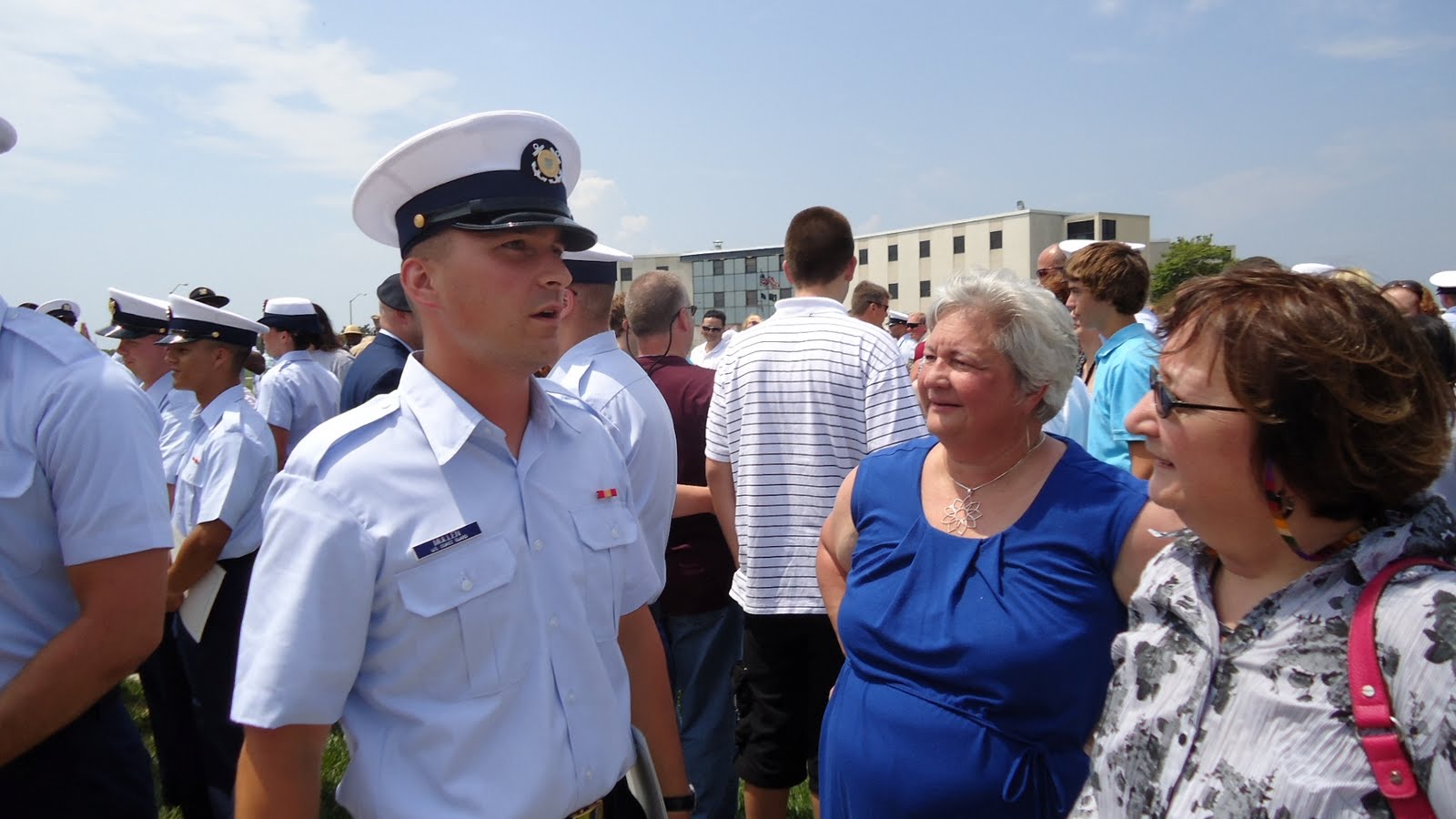
Our son just graduated on June 17th from the US Coast Guard Training Center at Cape May, New Jersey. These are some photos of graduation day. He just started an assignment at a small boat station(Point Allerton)in Hull, Massachusetts just south of Boston.


Donna and I are extremely proud of him.
May God bless him and all those in the service of others.

Monday, May 2, 2011

More Treasure


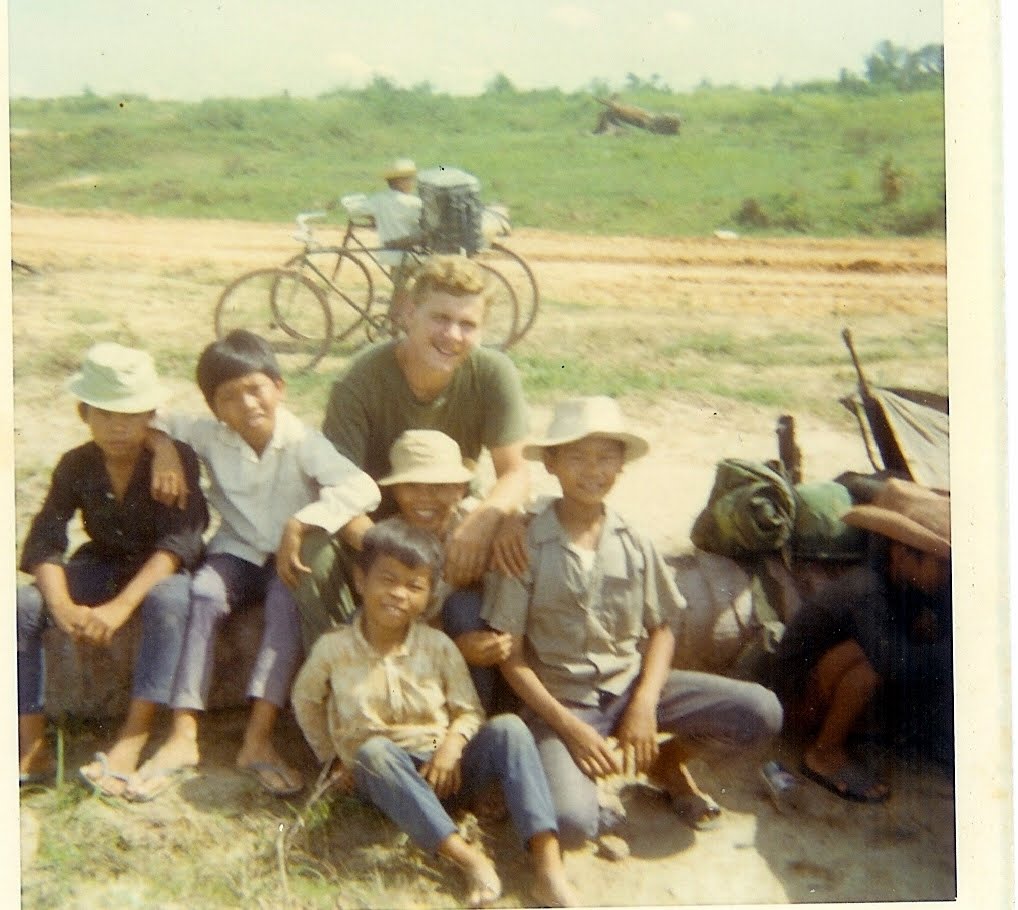
This is the only photo I have of Van. He's the one looking at the camera. We were walking up Highway One when I took the picture. He is resting his back because the rucksacks we carried weighted from 60-80lbs and we carried them in humid heat, many days exceeding 100 degrees. We were called "grunts" because that's exactly what we did after battling the awkward weight on our backs. They should have called us "turtles" because if you sat down with it still strapped to your back, you would need someone's extended arm to get up or master a movement mimicking a drunken dridel, slowly spinning from a kneeling position upright and hope you then don't spin back down as I often did.

Van Wray was from Stoneville, North Carolina, and spoke with the soft cadence of grace. He was better than most of us and better than Vietnam. He died on a terrible morning in May, 1970 and since that day on, the world was not quite as good. He is on the Vietnam Veterans Memorial Wall, Washington, DC, panel 10w-line 36. He was 21 years old when he died.


The amazing thing about this picture is that no children have a deformity or missing limb. Many kids did. As troops, we carried weapons and took our chances. Our only wish was to do the year and go back to the US, a place of relative safety and sense of normalcy. These kids' world was populated by unexploded ordnance and gunfire - that was their normal. It wasn't fair. It wasn't just. In Vietnam, any caring you wanted show ran into a lot of heavy traffic.

Among the civilians, our eyes viewed a constant harvest of needed compassion. I hated working the mountains, but there were no civilians there; just us and the NVA; no innocents and no children so there was a clarity and simplicity to the mountains and hills. In early spring after the monsoon season, our company was brought down to the lowlands and valleys where we got to see what 10 plus years of constant war can do to a people. There was not enough compassion to go around, but what we had we always gave to the kids.

After this photo was taken, the picture-taker ran off with the camera and I had to pay one of the kids $1.00 to get it back. I couldn't and didn't blame him, he just saw an opportunity to gain something of value.

In thinking further about compassion, at first it struck me as strange that when one of us died, that person was never spoken of again; almost as if we lacked compassion among ourselves. Initially, I thought it was a "jinx" thing since that term was mentioned often - a vague belief chasing its tail - randomness as a hoped for cause and affect phenomenon, but I then realized it was grounded on survival. We couldn't afford to talk openly and mourn our buddies amongst each other. That sadness could cause a lack of focus that could bump up against the here and now. We mourned, we just did it privately and quickly and put the sadness and loss on pause, knowing there would be time later to let the feelings flow. We had to be other people than ourselves until we got home.

Lt. Verdone and the Sergeant

On the left is Lt. Verdone who is the only one in our platoon that completed his year uninjured and made it back to his beloved California during my 7 months in country.
The sergeant on the right did not. I wrote about him in an earlier post, The Hurt Locker Hurts, March 8, 2010.
The Sergeant is on the Wall, panel 10W-line35. He was planning to be a college professor of English. He was 21 years old.
Steve Bittel(Kansas), Lassie, Al Tristan(Brownsville Texas), the arm of the handler.

One day in June, 1970, we were brought to an AO (area of operations) that no American unit had covered. We were spooked. As usual, we were not told much and imagine our surprise when our platoon was assigned point with a scout dog and handler. I ended up walking point on patrol one day in a mixed brown and white ocean of high grass with no break in the flatness; except I wasn't walking point because the dog and handler were in front of me. The trail was a wide path like a dirt jetty in that sea of grass and that trail had no curves on it,which made for an inviting fire lane for the "other team". The handler and the dog had no sense of noise discipline or combat awareness. The handler kept talking to the dog in a loud voice, walking with an uneven pace and generally not paying any attention to his surroundings. He and the dog kept slowing down which caused them to bunch up with me and those behind me: a big no-no since everyone then became an inviting target. I had almost reached the end of my string and a thought of accidental weapon discharge in his general direction was considered. Just to get his attention mind you since my whispers and increasingly frantic motions weren't working.

Then the dog stopped and sat on his hind legs.

He would not move and didn't care what the handler commanded. Both of us spread supine on the trail and couldn't see anything - even checking from different angles.

Then one of us saw it (I forget which one). The tripwire of a booby trap was usually slightly elevated an inch or two off the ground to be triggered from the gait of a boot, but this wire was laying on the ground, perfectly camouflaged, waiting for someone's slow shuffle of that boot. No human would notice, but the dog did. It could have won a major award in the booby trap category. The wire was attached to two hand frags on each side of the trail, covered with light debris. If I didn't trigger it, then one of those behind me would have, and taken out himself and maybe another.

I started to like the dog.

The photo was taken that night or another. Just for a short time, being around the dog allowed us to be human again. Remembered feelings of growing up with pets, remembered feelings of home. Lassie joined the platoon and became part of our lives for a short time and most of us would try and find reasons to be around him during any down time in the bush. I don't remember if I tried to swap out some C-Rats for some cans of dog food, but I probably tried.

After a time we went back to the firebase and one morning I was turning a corner on a sandbagged bunker when Lassie, tethered to a large chain, plunged for me, teeth showing and growling. He was a large and powerful German Shepard that could have seriously hurt or killed me. As luck would have it, I was able to jump just enough out of range of the chain. The handler came out of the bunker to see what the rumpus was about then nonchalantly started to pet the dog as if nothing had happened. After that, I made sure only to be around Lassie with the handler present.

I've heard that a journalist wrote a book about Vietnam and called it, Fire in the Lake. It seems a perfect description in a place where up is down and down is up. One day the dog saved my life and a short time later the dog tried to take it..Vietnam...Fire in the Lake.

I don't know where or when this picture was taken, but I'm pretty sure that's Doc Winder in the lower left hand corner. It looks like he was incidental to the photo, just quietly doing his job, taking care of us as a medic, getting water to purify or clean something. As I pointed out in a previous post, he was awarded the Congressional Medal of Honor for his actions on May 13, 1970, but as I see it, the Medal was awarded him and the medal should be proud. He lives on the Wall, David Francis Winder, age 21, panel 10w-line 37.

I wrote on the back of his photo, May 14, 1970, Nghai Hanh Valley. I cannot believe that one day after the worst day of our lives, I would be taking pictures. As I stated above, I wrote about part of the day on a previous post, March 8, 2010. On May 13th, our company walked into a buzz saw and had 20-25% casualties, many of them fatal. We were not given any artillery or gunship support because we were told it was a civilian populated area even though there were no civilians within sight. At the end of the day, after much blood and death, that support was given. So after the fight, our Company Commander, out of shear anger and frustration, called in a strike on an empty field.

As you can see, the photo doesn't have the usual smiles. I must have taken the picture more as a record to remember us by. A short time later I wrote a "just in case" letter giving suggestions about my burial arrangements. I didn't want to upset my parents so I sent it to my sister. After that day, I'm sure others did the same as well.

Picture on Left: Charlie White (Winston-Salem, NC), Vic again (wow-he's in a lot of photos!) Picture on Right: Kim, James Lucas, me

There were two kinds of heroes. Some were like Doc. Others were like Charlie White (Squad leader) and James Lucas. "Luke" and Charlie directed us in a decent and calm way. Through their efforts, we managed to consume some chunks of time in the bush knowing they were looking out for us. When they were scared, they said so; allowing us to feel that emotion also. They played no favorites and were looked up to by other members of the platoon. Sometimes you gain appreciation only by contrast and in a violent, unpredictable and frightening world, we had the direction and voices of Charlie and Jim to open the door for us from one day to the next.

I left before they did. Charlie had two purple hearts. If you didn't need to be dusted off from wounds and received a third, you won a cushy job in the rear. I hope Charlie got that 3rd purple heart without medical incident. James Lucas just wanted to make it home to his wife and kids in Birmingham, Alabama and as he once said, "never leave that city again." If that's what he wanted, I hope it came true.
This is Lt. Verdone's last day before the dreamed of DEROS (Date Estimated Return Over Seas). To his right is Al Tristan from Brownsville Texas, squatting with the bush hat.

Al came from a large family in Texas. Although computers were not in widespread use in 1970, he believed they were the future and wanted to go to school to learn everything he could about them, be successful, and help his parents provide for his brothers and sisters. He died in the first week of July.

We were patrolling in an area north of our firebase and approached a large rice paddy complex bordered by brush and tall palm trees on 3 sides, resembling the letter "U". The open apex of the "U" fronting one side of the paddy lay the village, a complex of thatched huts, some with thatched walls, some without. The paddies were squared with narrow berns of various widths, but none accommodating more than one person in line. It looked like a large checkerboard; some squares flooded with water and fertilizer, some dormant. Women were working in a line,, some with children, some without, planting rice while others were harvesting. Men were guiding the crude wooden plows powered by large water buffaloes. With the rice fields fronting the village and the village fronting the hills and mountains, it looked like a Vietnamese type Hudson River School oil landscape. Calm and peaceful.

We approached the rice field from the bottom of the "U" and experience dictated we would work our way through the treeline up to the village. Common sense always taught you to use the topography and never walk in the open unless you had to. But we had a brand new Company Commander whose mind only traversed an area containing arrogance and lack of that common sense. He thought in straight lines, not understanding when told by others who had been in country longer than he, that straight lines increased medivac traffic. No rush to go in straight lines, serpentine was safer and more effective; after all we had 365 days. Our squad was walking point for the company so we kicked off first across the open of the paddies. I remember Al and I were yelling at each other; nothing important, probably just scared at how unnatural and how wrong the open approach was. We took that fear out on each other, but we tried to take comfort that the villagers were working in the fields and the NVA/VC would never shoot at us through them: too many innocents in the area. They would abide by decency wouldn't they?

We were wrong.

They let our the first few members of the patrol get deep in the paddy complex so the main body of the patrol was exposed and like a light switch that went from the "off" to the "on" position, the NVA opened up on us from one side of the treeline. They must have used the women and children to judge distance, then used them as aiming stakes. Firing automatic weapons through the villagers and shooting them, to clear a firing lane to shoot us. When the shooting starts, time stops, so I don't remember how long the ambush lasted. We hugged the ground or dove into the water for protection as best we could. We couldn't really return fire since the villagers were in the way and trying to gain cover themselves. When the ambush ended I saw a medic from the second platoon run to a lump on the ground behind me. I went over to help and when I got there saw Al, the color and life draining out of him. The medic was frantically trying to find a wound to treat, but couldn't find any marks on the skin or blood. I held Al in a sitting position, cradling him as the medic ripped off his shirt. The medic finally found a small hole under his bandolier, a pin prick really, right over his heart. We were told he died in the dust-off chopper on the way back to the hospital, but he died on that rice paddy. We called Vietnam the "land of one mistake", but it didn't have to be your mistake that caused the problem.
Albert Flores Tristan, age 21, Brownsville Texas, died July 6, 1970-Vietnam Veterans Memorial Wall, panel 09w - line 125.

In the platoon, we tried to take care of each other as best we could. After Al died, I had seen enough. I reached the end of my string and couldn't sleep much. Three weeks after that day in the rice paddy I was shot around midnight right after standing guard. I wasn't killed while sleeping since I was on the surface of sleep and not really sleeping. I was able to react fast enough to dodge the rest of the strafing fire. So in a sense, Al took care of me three weeks after he was killed.
------------------------------------------
I read The Things They Carried by Tim O'Brien. He is a fine writer and winner of a National Book Award. He was in the same unit as me, and worked in the same area of the country so I wanted his thoughts. I found reading the book unsettling because he seemed to try and gain meaning and value within himself to made sense of the war. I think he failed because Vietnam, or any war, is a bigger experience than any of us and the only way to realize it (we can never conquer it) is to look outside ourselves to reach some accommodation. For me it was God. Doesn't work for you? Then fine, find something else, but I think you have to explore something larger than you, otherwise your thoughts will just travel in a large circle, never growing, never gaining - just undirected movement of thought. Just my 2 cents.

And 2 cents more.

The Vietnam Veterans Memorial Wall in Washington DC is a wonderful and magnificent display. It is awe-inspiring and people become quiet when they approach it. If you get a chance, visit it - you don't have to know anyone on the Wall.

I will consider voting for any politician or any party if they pledge to spend 1/2 hour a year at the Wall and then go over to the Korean War memorial and look at the angst, fear, and dread of the soldier statues on patrol. I am not a pacifist, but I am anti-war. I think we need more anti-war politicians or politicians who are more thoughtful about deployment. The events I have written about occurred 40 years ago. Most of our attention should be on those currently in uniform, but I wanted to show you my friends. They lived 40 years ago.

They mattered.

William James Olson, age 21, Chicago, panel 10w - line 35
David Winder (Doc), age 21, Pennsylvania, panel 10w - line 37
Willmer Matson, age 20, Nebraska, panel 13w - line 131
Rhea (Billy the Kid), Kidd, age 26, Kentucky, panel 10w - line 34
Van T Wray, age 21, No. Carolina, panel 10w - line 36
Arthur Munson, age 20, Colorado, panel 10w - line 35
Albert Flores Tristan, age 21, Texas panel 09w - line 125
Richard Humphrey, age 20, Maryland, panel 10w - line 33
Curtis Ringhofer, age 25, Minnesota, panel 10w - line 36
Raymond Souza, age 20, California, panel 10w - line 37

There it is.