I guess I was wrong on the February 1st posting, Travels 2010: Stand-bye, when I predicted the Parkens' new addition would be a girl. She turned out to be a he. I guess God had other plans. I am sure that the infant Parken, born last March 16th, at almost 8 pounds, will be extraordinary in all aspects - no doubt at all. By age 5, he will be able to dead lift three times his weight. By age 10, during commercial breaks of Scooby-Doo Where are You?, he will be plotting conventions of multi-variable calculus and vector analysis. As a teenager he will clean up his own room and help with the dishes without being told...every night! After his undergraduate scholarship to Harvard, he will matriculate to Yale Law School and in his spare time pick up an MBA at the Wharton Business School at UP. Growing into adulthood he will look like George Clooney, have the luck of Barak Obama and the current pitching rotation of the NY Yankees, the empathy of Mother Teresa, and the sagacity of King Solomon.
After college he will excel in his chosen field. Perhaps through stunning managerial tenacity and innovative use of self-invented technology, he will reduce the list price of a Rolls Royce Phantom V12 from the current $450,000 to $18,500 hereby giving men smiles everywhere; or even more challenging, develop a schake mushroom that looks and tastes good.
He will be number one on the power rotation of the prettiest girls in the world, but will end up foregoing empty celebrity and style to marry someone with depth and common sense. They will live happily ever after.
The wedding? It will be spectacular! His event will make Kate and Prince Andrew's wedding soiree at Westminster Abbey this spring look like a celebration of crop day in Cumbria. Perhaps an outside wedding. The South Rim of the Grand Canyon or the vast meadow acreage fronting the Grand Tetons in Wyoming. How much could it cost to rent Jackson Hole for the day? It should be a cinch.
He will never be assigned a middle seat his entire life and will drafted for a Presidential run before he is 40 years old.
He will be rich and support his parents in their later years since they depleted their retirement savings renting that National Park for the wedding... he will help them with dishes...every night!
How do I know all this? Really? Why from the pedigree of his moniker. Let me introduce you to:
James Elias Parken
Monday, July 4, 2011
Monday, June 27, 2011
Parents' Privilege
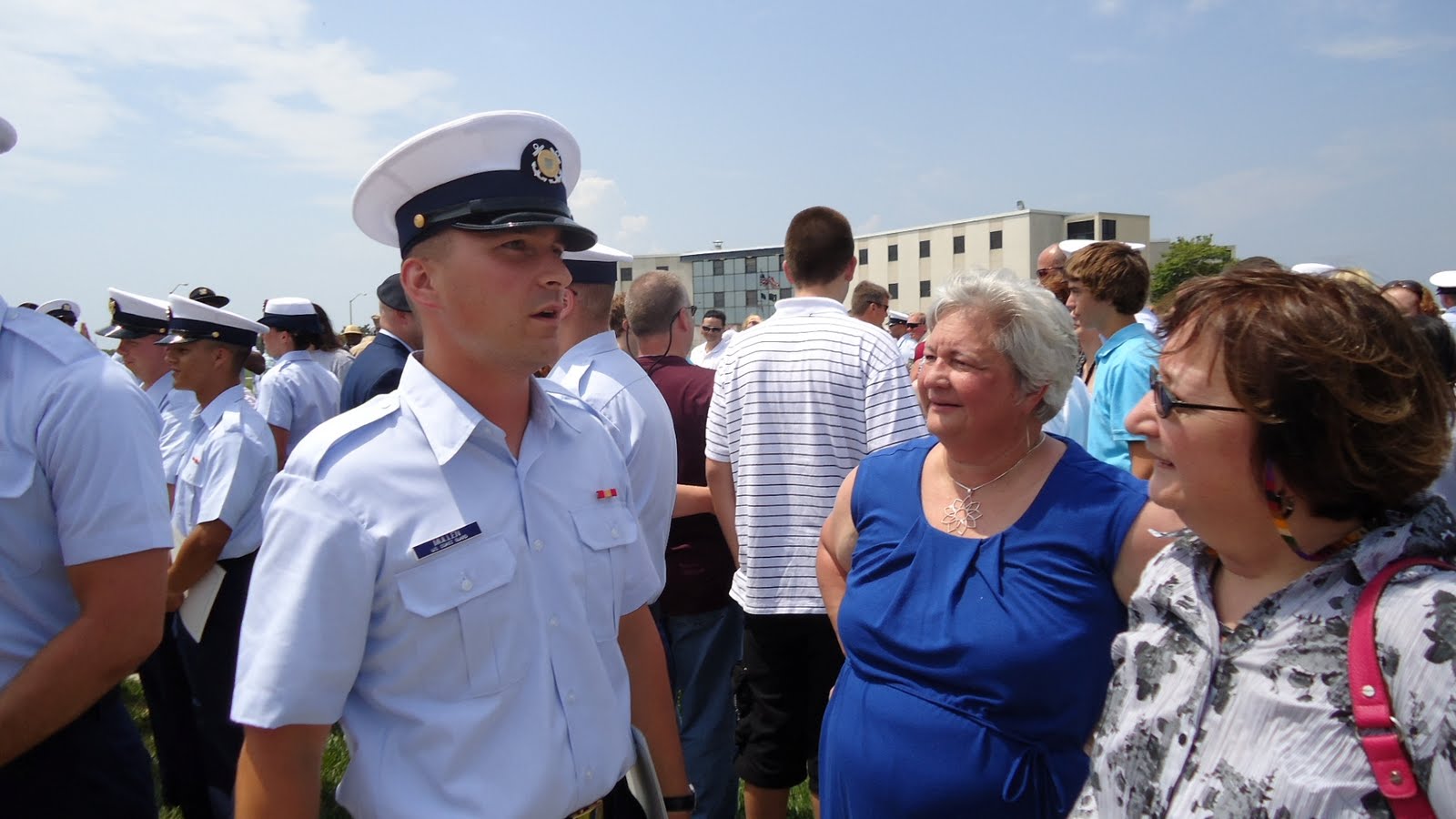
Our son just graduated on June 17th from the US Coast Guard Training Center at Cape May, New Jersey. These are some photos of graduation day. He just started an assignment at a small boat station(Point Allerton)in Hull, Massachusetts just south of Boston.
Donna and I are extremely proud of him.
May God bless him and all those in the service of others.
Monday, May 2, 2011
More Treasure
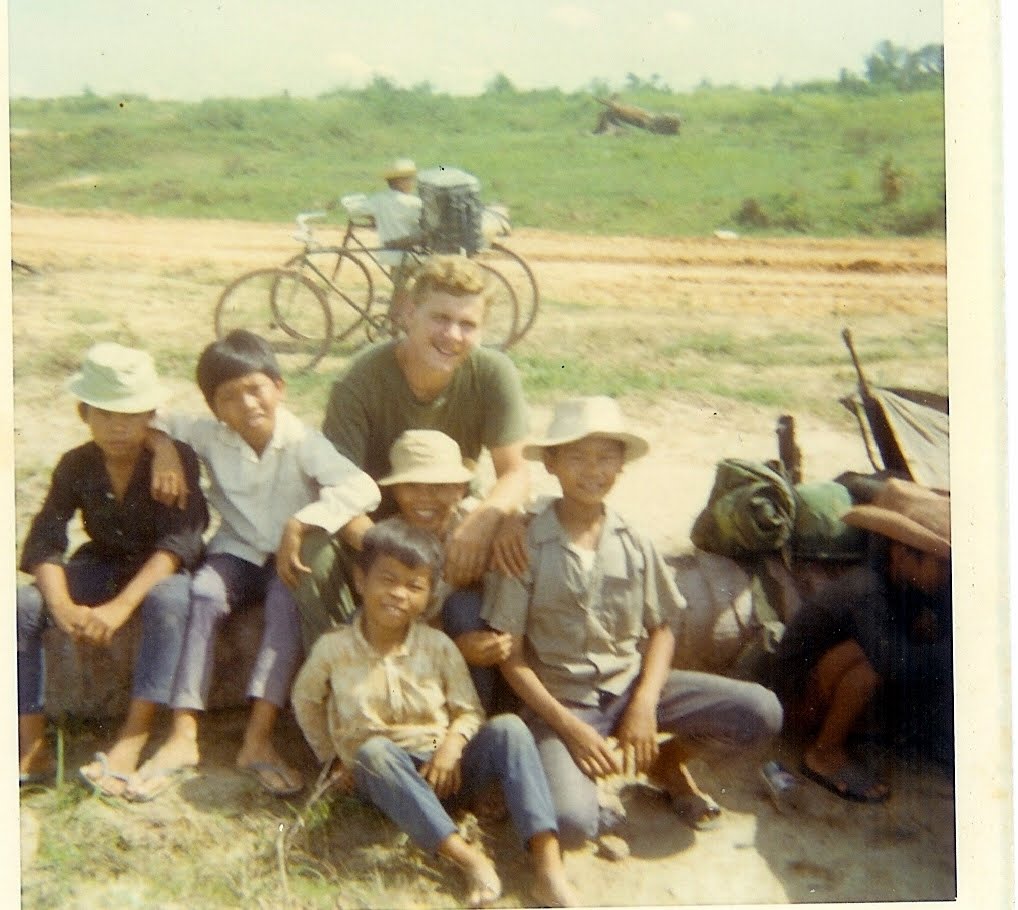
This is the only photo I have of Van. He's the one looking at the camera. We were walking up Highway One when I took the picture. He is resting his back because the rucksacks we carried weighted from 60-80lbs and we carried them in humid heat, many days exceeding 100 degrees. We were called "grunts" because that's exactly what we did after battling the awkward weight on our backs. They should have called us "turtles" because if you sat down with it still strapped to your back, you would need someone's extended arm to get up or master a movement mimicking a drunken dridel, slowly spinning from a kneeling position upright and hope you then don't spin back down as I often did.
Van Wray was from Stoneville, North Carolina, and spoke with the soft cadence of grace. He was better than most of us and better than Vietnam. He died on a terrible morning in May, 1970 and since that day on, the world was not quite as good. He is on the Vietnam Veterans Memorial Wall, Washington, DC, panel 10w-line 36. He was 21 years old when he died.
The amazing thing about this picture is that no children have a deformity or missing limb. Many kids did. As troops, we carried weapons and took our chances. Our only wish was to do the year and go back to the US, a place of relative safety and sense of normalcy. These kids' world was populated by unexploded ordnance and gunfire - that was their normal. It wasn't fair. It wasn't just. In Vietnam, any caring you wanted show ran into a lot of heavy traffic.
Among the civilians, our eyes viewed a constant harvest of needed compassion. I hated working the mountains, but there were no civilians there; just us and the NVA; no innocents and no children so there was a clarity and simplicity to the mountains and hills. In early spring after the monsoon season, our company was brought down to the lowlands and valleys where we got to see what 10 plus years of constant war can do to a people. There was not enough compassion to go around, but what we had we always gave to the kids.
After this photo was taken, the picture-taker ran off with the camera and I had to pay one of the kids $1.00 to get it back. I couldn't and didn't blame him, he just saw an opportunity to gain something of value.
In thinking further about compassion, at first it struck me as strange that when one of us died, that person was never spoken of again; almost as if we lacked compassion among ourselves. Initially, I thought it was a "jinx" thing since that term was mentioned often - a vague belief chasing its tail - randomness as a hoped for cause and affect phenomenon, but I then realized it was grounded on survival. We couldn't afford to talk openly and mourn our buddies amongst each other. That sadness could cause a lack of focus that could bump up against the here and now. We mourned, we just did it privately and quickly and put the sadness and loss on pause, knowing there would be time later to let the feelings flow. We had to be other people than ourselves until we got home.
Lt. Verdone and the Sergeant
On the left is Lt. Verdone who is the only one in our platoon that completed his year uninjured and made it back to his beloved California during my 7 months in country.
The sergeant on the right did not. I wrote about him in an earlier post, The Hurt Locker Hurts, March 8, 2010.
The Sergeant is on the Wall, panel 10W-line35. He was planning to be a college professor of English. He was 21 years old.Steve Bittel(Kansas), Lassie, Al Tristan(Brownsville Texas), the arm of the handler.
One day in June, 1970, we were brought to an AO (area of operations) that no American unit had covered. We were spooked. As usual, we were not told much and imagine our surprise when our platoon was assigned point with a scout dog and handler. I ended up walking point on patrol one day in a mixed brown and white ocean of high grass with no break in the flatness; except I wasn't walking point because the dog and handler were in front of me. The trail was a wide path like a dirt jetty in that sea of grass and that trail had no curves on it,which made for an inviting fire lane for the "other team". The handler and the dog had no sense of noise discipline or combat awareness. The handler kept talking to the dog in a loud voice, walking with an uneven pace and generally not paying any attention to his surroundings. He and the dog kept slowing down which caused them to bunch up with me and those behind me: a big no-no since everyone then became an inviting target. I had almost reached the end of my string and a thought of accidental weapon discharge in his general direction was considered. Just to get his attention mind you since my whispers and increasingly frantic motions weren't working.
Then the dog stopped and sat on his hind legs.
He would not move and didn't care what the handler commanded. Both of us spread supine on the trail and couldn't see anything - even checking from different angles.
Then one of us saw it (I forget which one). The tripwire of a booby trap was usually slightly elevated an inch or two off the ground to be triggered from the gait of a boot, but this wire was laying on the ground, perfectly camouflaged, waiting for someone's slow shuffle of that boot. No human would notice, but the dog did. It could have won a major award in the booby trap category. The wire was attached to two hand frags on each side of the trail, covered with light debris. If I didn't trigger it, then one of those behind me would have, and taken out himself and maybe another.
I started to like the dog.
The photo was taken that night or another. Just for a short time, being around the dog allowed us to be human again. Remembered feelings of growing up with pets, remembered feelings of home. Lassie joined the platoon and became part of our lives for a short time and most of us would try and find reasons to be around him during any down time in the bush. I don't remember if I tried to swap out some C-Rats for some cans of dog food, but I probably tried.
After a time we went back to the firebase and one morning I was turning a corner on a sandbagged bunker when Lassie, tethered to a large chain, plunged for me, teeth showing and growling. He was a large and powerful German Shepard that could have seriously hurt or killed me. As luck would have it, I was able to jump just enough out of range of the chain. The handler came out of the bunker to see what the rumpus was about then nonchalantly started to pet the dog as if nothing had happened. After that, I made sure only to be around Lassie with the handler present.
I've heard that a journalist wrote a book about Vietnam and called it, Fire in the Lake. It seems a perfect description in a place where up is down and down is up. One day the dog saved my life and a short time later the dog tried to take it..Vietnam...Fire in the Lake.
I don't know where or when this picture was taken, but I'm pretty sure that's Doc Winder in the lower left hand corner. It looks like he was incidental to the photo, just quietly doing his job, taking care of us as a medic, getting water to purify or clean something. As I pointed out in a previous post, he was awarded the Congressional Medal of Honor for his actions on May 13, 1970, but as I see it, the Medal was awarded him and the medal should be proud. He lives on the Wall, David Francis Winder, age 21, panel 10w-line 37.
I wrote on the back of his photo, May 14, 1970, Nghai Hanh Valley. I cannot believe that one day after the worst day of our lives, I would be taking pictures. As I stated above, I wrote about part of the day on a previous post, March 8, 2010. On May 13th, our company walked into a buzz saw and had 20-25% casualties, many of them fatal. We were not given any artillery or gunship support because we were told it was a civilian populated area even though there were no civilians within sight. At the end of the day, after much blood and death, that support was given. So after the fight, our Company Commander, out of shear anger and frustration, called in a strike on an empty field.
As you can see, the photo doesn't have the usual smiles. I must have taken the picture more as a record to remember us by. A short time later I wrote a "just in case" letter giving suggestions about my burial arrangements. I didn't want to upset my parents so I sent it to my sister. After that day, I'm sure others did the same as well.
Picture on Left: Charlie White (Winston-Salem, NC), Vic again (wow-he's in a lot of photos!) Picture on Right: Kim, James Lucas, me
There were two kinds of heroes. Some were like Doc. Others were like Charlie White (Squad leader) and James Lucas. "Luke" and Charlie directed us in a decent and calm way. Through their efforts, we managed to consume some chunks of time in the bush knowing they were looking out for us. When they were scared, they said so; allowing us to feel that emotion also. They played no favorites and were looked up to by other members of the platoon. Sometimes you gain appreciation only by contrast and in a violent, unpredictable and frightening world, we had the direction and voices of Charlie and Jim to open the door for us from one day to the next.
I left before they did. Charlie had two purple hearts. If you didn't need to be dusted off from wounds and received a third, you won a cushy job in the rear. I hope Charlie got that 3rd purple heart without medical incident. James Lucas just wanted to make it home to his wife and kids in Birmingham, Alabama and as he once said, "never leave that city again." If that's what he wanted, I hope it came true.
This is Lt. Verdone's last day before the dreamed of DEROS (Date Estimated Return Over Seas). To his right is Al Tristan from Brownsville Texas, squatting with the bush hat.
Al came from a large family in Texas. Although computers were not in widespread use in 1970, he believed they were the future and wanted to go to school to learn everything he could about them, be successful, and help his parents provide for his brothers and sisters. He died in the first week of July.
We were patrolling in an area north of our firebase and approached a large rice paddy complex bordered by brush and tall palm trees on 3 sides, resembling the letter "U". The open apex of the "U" fronting one side of the paddy lay the village, a complex of thatched huts, some with thatched walls, some without. The paddies were squared with narrow berns of various widths, but none accommodating more than one person in line. It looked like a large checkerboard; some squares flooded with water and fertilizer, some dormant. Women were working in a line,, some with children, some without, planting rice while others were harvesting. Men were guiding the crude wooden plows powered by large water buffaloes. With the rice fields fronting the village and the village fronting the hills and mountains, it looked like a Vietnamese type Hudson River School oil landscape. Calm and peaceful.
We approached the rice field from the bottom of the "U" and experience dictated we would work our way through the treeline up to the village. Common sense always taught you to use the topography and never walk in the open unless you had to. But we had a brand new Company Commander whose mind only traversed an area containing arrogance and lack of that common sense. He thought in straight lines, not understanding when told by others who had been in country longer than he, that straight lines increased medivac traffic. No rush to go in straight lines, serpentine was safer and more effective; after all we had 365 days. Our squad was walking point for the company so we kicked off first across the open of the paddies. I remember Al and I were yelling at each other; nothing important, probably just scared at how unnatural and how wrong the open approach was. We took that fear out on each other, but we tried to take comfort that the villagers were working in the fields and the NVA/VC would never shoot at us through them: too many innocents in the area. They would abide by decency wouldn't they?
We were wrong.
They let our the first few members of the patrol get deep in the paddy complex so the main body of the patrol was exposed and like a light switch that went from the "off" to the "on" position, the NVA opened up on us from one side of the treeline. They must have used the women and children to judge distance, then used them as aiming stakes. Firing automatic weapons through the villagers and shooting them, to clear a firing lane to shoot us. When the shooting starts, time stops, so I don't remember how long the ambush lasted. We hugged the ground or dove into the water for protection as best we could. We couldn't really return fire since the villagers were in the way and trying to gain cover themselves. When the ambush ended I saw a medic from the second platoon run to a lump on the ground behind me. I went over to help and when I got there saw Al, the color and life draining out of him. The medic was frantically trying to find a wound to treat, but couldn't find any marks on the skin or blood. I held Al in a sitting position, cradling him as the medic ripped off his shirt. The medic finally found a small hole under his bandolier, a pin prick really, right over his heart. We were told he died in the dust-off chopper on the way back to the hospital, but he died on that rice paddy. We called Vietnam the "land of one mistake", but it didn't have to be your mistake that caused the problem.
Albert Flores Tristan, age 21, Brownsville Texas, died July 6, 1970-Vietnam Veterans Memorial Wall, panel 09w - line 125.
In the platoon, we tried to take care of each other as best we could. After Al died, I had seen enough. I reached the end of my string and couldn't sleep much. Three weeks after that day in the rice paddy I was shot around midnight right after standing guard. I wasn't killed while sleeping since I was on the surface of sleep and not really sleeping. I was able to react fast enough to dodge the rest of the strafing fire. So in a sense, Al took care of me three weeks after he was killed.
------------------------------------------
I read The Things They Carried by Tim O'Brien. He is a fine writer and winner of a National Book Award. He was in the same unit as me, and worked in the same area of the country so I wanted his thoughts. I found reading the book unsettling because he seemed to try and gain meaning and value within himself to made sense of the war. I think he failed because Vietnam, or any war, is a bigger experience than any of us and the only way to realize it (we can never conquer it) is to look outside ourselves to reach some accommodation. For me it was God. Doesn't work for you? Then fine, find something else, but I think you have to explore something larger than you, otherwise your thoughts will just travel in a large circle, never growing, never gaining - just undirected movement of thought. Just my 2 cents.
And 2 cents more.
The Vietnam Veterans Memorial Wall in Washington DC is a wonderful and magnificent display. It is awe-inspiring and people become quiet when they approach it. If you get a chance, visit it - you don't have to know anyone on the Wall.
I will consider voting for any politician or any party if they pledge to spend 1/2 hour a year at the Wall and then go over to the Korean War memorial and look at the angst, fear, and dread of the soldier statues on patrol. I am not a pacifist, but I am anti-war. I think we need more anti-war politicians or politicians who are more thoughtful about deployment. The events I have written about occurred 40 years ago. Most of our attention should be on those currently in uniform, but I wanted to show you my friends. They lived 40 years ago.
They mattered.
William James Olson, age 21, Chicago, panel 10w - line 35
David Winder (Doc), age 21, Pennsylvania, panel 10w - line 37
Willmer Matson, age 20, Nebraska, panel 13w - line 131
Rhea (Billy the Kid), Kidd, age 26, Kentucky, panel 10w - line 34
Van T Wray, age 21, No. Carolina, panel 10w - line 36
Arthur Munson, age 20, Colorado, panel 10w - line 35
Albert Flores Tristan, age 21, Texas panel 09w - line 125
Richard Humphrey, age 20, Maryland, panel 10w - line 33
Curtis Ringhofer, age 25, Minnesota, panel 10w - line 36
Raymond Souza, age 20, California, panel 10w - line 37
There it is.
Friday, April 15, 2011
Treasure
FireBase 411, 1970 L to R Vic Smidt (Michigan), Sonny Barth (Oregon),me ,Doc Elliott (California), Steve Bittel (Kansas),Bottom: Howard Linhardt (Illinois), Mike Lomolino (Illinois).
Americal Division
11th Light Infantry Brigade
3rd Battalion, 1st Inf
Alpha Company, 1st platoon
Quang Nghai Valley, I Corps Vietnam
Except for our Medic, Doc Winder, who won the Congressional Medal of Honor (see previous post), we were not heroes. We were not part of any large military operations. No one will write a book about us. No one will make a movie about us. Our time "in country", in 1970, probably ran in the middle of the pack. We had it better than many, worse than some. We were for the most part draftees who tried to do our year and come home, let time give our Vietnam memories a gracious death and get on with our lives - most of us made it back, some of us did not - those that did not are the treasure.
When I was recovering from gunshot wounds in Chelsea Naval Hospital near Boston, in 1970-71, my sister Nancy bought me a non-descript photo album to put about 20 photos I had taken when I was in Vietnam. A lot of us carried a small Kodak Instamatic buried in our rucksack or when on the firebase, in our chest fatigue pocket so that when conditions were right (usually on the firebase and not humping in the mountains), we would take some pictures. Looking at them years later, it appears I took too many of me and not enough of the others, but I filled the album with the photos, put it away and rarely looked at it.
When you enter combat, you enter into a contradiction that never unravels. You want to use willful forgetfulness to overcome the experience, but always keep those who you were with in your heart. Forget the war, remember the people; especially those who never came back. I don't need photos to do that, but looking at them now helps. Someone once said that the strangest feeling he ever had was the first time he parachuted out of an airplane, because when he jumped, his brain had no synaptic path for that experience, no point of reference he could relate the feelings to. Combat is like that. Even a year after I returned, I was taking a nap at home and my mother made the mistake of waking me up by tapping me on the shoulder - I took a swing at her before I had even gained consciousness. Another guy I served with made it home to his parent's house and after the first night he went out to the backyard and dug a fox hole. He knew it served no practical purpose, but it made him feel secure; after all, he had slept in or next to one for a year. So I know we are all a sum of our past experiences - they are us - but at the same time those experiences can burrow into your future and eat its way into your individual and chronological life-line: birth, school, more school, war, adult employment, marriage, children, housing, retirement and death. War doesn't deserve a place in that line; its nature is so foreign, so disconnected, so dissonant. If life's a house, then combat builds itself an addition on the property - not attached or associated to the main structure.
I don't want to overdo this, but I always kept the guys I knew well, the ones who never came back, close to me. I don't think this is unique to me. I rarely looked at the pictures and tried not to think about Vietnam and to a large degree I succeeded. I've had a good life. Time really does heal. But at some point, when I got my first, real adult job, I took them with me and Wilson got a real adult job with me. When I met the love of my life, Donna, Doc and Al got married with me. When I had a child, Van had a child with me and when I retire, Al and Munson will retire with me. At some brief point in those events, I thought about them, remembered them and was humbled that I was experiencing good things that they never would experience. If life is a long race, they only got to run a few laps.
Then one day I couldn't find the album. Donna and I took a one day trip up to Washington DC to see the Smithsonian and the Washington Mall. I wanted to show her the Vietnam Veterans Memorial Wall near the Lincoln monument, but when I got there couldn't remember the name of someone I held in my arms as he died on hot morning in July, 1970. My forgetfulness really bothered me and when I got back home, I scoured the home for the photo album. I was sure I had everyone's name written on the back of the pictures (some I did, others not). I looked everywhere. We had downsized our house 5 years before and I feared I had lost the album during the housing move. I searched every box and drawer and the more I searched, the more I realized it was the most important thing I owned and like a fool, had lost it. Then one day, last November, I was in the garage looking for something in a carton and I found the photos under some old picture frames.
They need to be shared.
Howard, me, Sonny, Rex Morris (Texas)
I'm pretty sure this was taken the first day back on the Hill. It was the first day I walked point which accounts for everyone sweating. Every 4 weeks or so we would be cycled in from the bush and surrounding mountains, an area generally called "The Horseshoe" North of a spine of mountains called the Central Highlands.
As a sports writer once said of an athlete he was covering: "Not only isn't he beloved, he isn't even be-liked". It was not a place anyone had real affection for, but being behind sandbags, sapper wire, and barrels of buried phu gas, and clear fields of fire, afforded us more protection than crouching behind elephant grass or a hastily dug hole. When researching this post I was amazed to find a website about the firebase 411 so perhaps I was wrong (just Google "FSB 411" for the site). We also got relief from the C-Rats (the cans of ham and eggs and caraway cheese would make any alternative an epicurean delight...bring on the chipped beef!) We also showered (what, once every 4 weeks wasn't enough?) and a haircut. But best of all was the safety. We got mortared every once in a while, and another company, during their stay, underwent a sapper attack, but overall it was quiet.James Pabone (New York), Sonny, Howard: the hills, valleys and mountains ran forever to the Laos border.
Walking point was like being a canary in a coal mine. You were first in line while walking on patrol and if something bad was going to happen, it would happen to you first. If you were shot or stepped on a booby trap then everyone else would know and respond accordingly. It was policy that married guys and those who were sole support of someone did not walk point. After 2 or 3 weeks, you would develop "the shakes", a constant trembling from the stress and without any words spoken; another would take over the slot. Not only was it dangerous and emotionally draining, but you would be on intellectual overload while on patrol. Why? Think about this.
While you are walking on a mountain trail slowly, eyes constantly moving in the 180 degree ark in front of you, you would constantly be running scenarios in your head. That stand of trees off to the right, would it make a good ambush site for the NVA? Does it have a good backdoor for them? Could the fire be laid down for maximum killing effect? No, the areas at my 10 o'clock by the rocks would be better cover. They could kill me better from there. Wait, I need to check up in the trees by the bend, but I can't see real well, too may shadows. And on and on. Me, I wasn't that good at point. I was too frightened and cautious and I was shot before I developed any proficiency at it.
Oh, and I almost forgot...the booby traps.
If there were traps, the point man would focus only the immediate ground in front of him and never looking up to canvas the terrain; thinking about each step. The cover man (2nd in line) would then scan everything in front and to the sides. Howard was our best point man as I recall. He had the ability to balance the possibility of his finality with a reasonable pace of forward movement; and he was no fool. We all trusted him with our lives. Needless to say if the point man made a mistake, he would die or become wounded, but also, his mistake could cost others behind him their lives. Just what was needed - more stress.Ngi Hanh Valley after a patrol: Howard, James Lucas (B'ham, Alabama), Kim (Vietnam), me.
Much of the time our platoon was assigned Kim, a Chu Hoi or Kit Carson Scout. He was a Viet Cong who fought the Americans for years, then surrendered and acted as our guide. He lived with his wife and children just outside the firebase. He was very resourceful and had good survival instincts. We didn't completely trust him, but we never lost anyone when he was guiding us. It was expected he would not fire his weapon except for immediate personal protection. He was a mixed blessing as well. His presence meant our platoon was always up front and there were times when we were scheduled to be CAed (helicoptered) into the Horseshoe and he didn't show up. When that happened we knew it was going to be bad - and it always was; he was an unfailing barometer of trouble I hope though he was able to get out of Vietnam in 1975 when the war ended with his wife and kids; if he didn't I'm sure they all died.
To be continued in another post
Tuesday, March 22, 2011
Doc, Rest.....In Peace
Update: Tomorrow, May 27 2013, is Memorial Day. To paraphrase Lincoln in the Gettysburg Address, those of little note (me), will long remember...people like Doc. On the day he died in 1970, our rifle platoon deployed into a large scale ambush, we tried to handle the situation as best we could and we did it after gathering what little cover and concealment we could find, even when it was just flat ground. We wanted to be safe first, react second. Yes, that day many, against instinct, abandoned that safety when the circumstances scream we do so, such as pulling out downed helicopter crews, laying down supressing fire, and evacuating wounded - all under hostile fire. But, for the most part, it was courage in short bursts; like the intermitent clatter of an M-60 machine gun.
But not Doc. On the day he died, he was different. He didn't think of cover. When he was with my squad early that morning, he stayed in open ground, calmly walking from body to body, ignoring explosions, ignoring getting shot at...he did his job. He was completely focused - giving assistance - giving love - helping us - trying to keep everyone alive.
The citation below barely touches on what he did that day for us. We will remember you always, Doc. Memorial Day is your day.
--------------------------
Doc,
In a place of casual violence where caring and compassion were on a short leash, you listened to us with our concerns, fixed us up when we had cuts, infections, jungle skin conditions, accidents, stepped on a booby trap or got shot. In a place where few listened to us, you listened better than any person outside a confessional I have ever come in contact with. You kept us well and because of your efforts you helped us to endure. Your quiet, encouraging conversation and sly humor were what we needed and you worried about us like a mother hen.
I didn't know until several days ago that you were awarded the medal. On that terrible day in May you did what you always did; you took care of us and paid an awful price.
Those who were there will never forget you.
We carry you with us always.
You were one of God's better efforts.
Rest in peace Doc.
Medal of Honor Citation
DAVID FRANCIS WINDER
Private First Class, U.S. Army
Headquarters and Headquarters Company, 3d Battalion, 1st Infantry, 11th Infantry Brigade, Americal Division. Place and Date: Republic of Vietnam, 13 May 1970.
Entered Service at: Columbus, Ohio.
Born :10 August 1946, Edinboro, Pa.
Pfc. Winder distinguished himself while serving in the Republic of Vietnam as a senior medical aidman with Company A. After moving through freshly cut rice paddies in search of a suspected company-size enemy force, the unit started a thorough search of the area. Suddenly they were engaged with intense automatic weapons and rocket propelled grenade fire by a well entrenched enemy force. Several friendly soldiers fell wounded in the initial contact and the unit was pinned down. Responding instantly to the cries of his wounded comrades, Pfc. Winder began maneuvering across approximately 100 meters of open, bullet-swept terrain toward the nearest casualty. Unarmed and crawling most of the distance, he was wounded by enemy fire before reaching his comrades. Despite his wounds and with great effort, Pfc. Winder reached the first casualty and administered medical aid. As he continued to crawl across the open terrain toward a second wounded soldier he was forced to stop when wounded a second time. Aroused by the cries of an injured comrade for aid, Pfc. Winder's great determination and sense of duty impelled him to move forward once again, despite his wounds, in a courageous attempt to reach and assist the injured man. After struggling to within 10 meters of the man, Pfc. Winder was mortally wounded. His dedication and sacrifice inspired his unit to initiate an aggressive counter assault which led to the defeat of the enemy. Pfc. Winder's conspicuous gallantry and intrepidity in action at the cost of his life were in keeping with the highest traditions of the military service and reflect great credit on him, his unit and the U.S. Army.
Medal of Honor
Awarded to PFC David F. Winder
Sunday, February 20, 2011
Travels 2010: San Diego and Las Vegas
Travel-wise we stayed close to home in 2010 since my ambulation was still not 100% and also since my ankle is made of titanium, I could be worth money in 3rd world countries.
We knew of a couple that moved from San Diego to Cary, North Carolina, purchased a very nice house, moved into it then one spouse went into their new laundry room and started to cry because they did not live in San Diego anymore. That peeked interest. Speaking with anyone who lives in San Diego, was born and raised there, or like our friends, lived there for a time and left; they all claimed it was the best place in the US to live. Never asked why, wanted to find our ourselves.
Both Donna and I had been to Southern California before, just not San Diego. We found the area to be a wonderful place, Mediterranean climate, nice people, and many points of interest. We also noticed high taxes, the worst traffic in the world, and a huge density of people and structures. Plus Gertrude Stein could have been speaking about the Los Angeles area and not about Oakland when she said it "lacked theme". Still Donna and I wanted to find out what was so great about San Diego so we flew there last September.
Our first night we went to “Bring Your Pet Night” at Petco Baseball stadium just for the novelty of seeing a lot of dogs at a baseball game. The next several days we went to Balboa Park, a city park. The Park was wonderful! Balboa Park contains the world famous SD Zoo and 15 impressive buildings of Moorish, Italian, and Spanish influence surrounded by ornate, brightly tiled fountains and gorgeous flower gardens. Each building is a museum or cultural center. There is also an open- air Pipe Organ Pavilion with nightly organ concerts – we went twice.
Being in Southern California, we also drove up to La Jolla Cove to see the sea lions and rich people. We ate at Georges by the Sea in downtown La Jolla that had wonderful scenic ocean views. They sat us by the kitchen though, since we looked like most patrons’ grandparents and were probably not helped by the fact my khaki’s had the ever present soup stain from the previous meal - not black jeans with the pre-cut designer knee holes and the Mercedes CL600 convertible which the pants could sit in. The wait staff gave both hurried and slow service, probably unsure if we were early or late to our AARP meeting - the food was very good though. We then drove south to the less affluent Pacific Beach that was filled with an eclectic mix of young families, old folks, teenagers, and on the boardwalk, young people with tattoos and the pallor of a recent stay at a correctional facility. More our kind of people.
We took a city tour that brought us across the Bay to the iconic Hotel del Coronado, a landmark structure with large wings of white clapboards topped by red-shingled roof expanses and turrets. The back of the "Del" faced the beach and was landscaped with large swimming pools skirted with hundreds of white chaise lounges and very unique and beautiful plants. Donna knew many of the flower varieties without looking at the attending signs, I of course, added to the enjoyment by saying, "Look, a plant!" The beach looked perfect, but we couldn't understand why everyone was at the pool and not many on the beach. Why spend $500 a night on a beach vacation and go to the pool? It would be like getting a ticket to Augusta and then spending your time playing miniature golf. We knew the answer to the riddle as several Navy fighters skidded low across the beach (San Diego has a very large naval presence) and provided the same decibel level as the front row of a Stones concert. The backwash from the jet engines probably gave birth to the beach's divots. Just hope they wait to start the strafing runs during the off-season.
For such a large city, San Diego was easy to get around with one stipulation. If you travel there, be sure you have a map of the area with the shopping malls clearly marked. San Diegoans seem to place them in high regard. Directions always seemed to be given by major highways and malls. ”Right, you want to take a left about two miles before you hit Fashion Valley Mall… if you approach the Westfield Mall, turn around.” San Diego? People like it because it is Southern California without most of the attendant problems – size, traffic, etc….but has malls. If they ever put up a public sculpture downtown it will probably be a statute of a shopper.
LAS VEGAS
As you know, I have been extremely concerned with our economy. Since the past and present Administration has made no headway increasing the M1 money supply to kick-start aggregate lending. I, well, you know the old saying, “if you want to get something done….”
So I decided to take Donna to Las Vegas for two days on the way back to North Carolina.
We also stopped off to see our friends Kathy and Jay Healey: photo provided (I’m the handsome one.) Always a unique place, Las Vegas routinely commits a hit-and-run on the notions of a mundane and ordinary life. A pile of neon that stands in protest of “buy and hold, keep your nose to the grindstone, and a penny earned.” A city where the hare wins the race and still has time for the casino buffet. In the morning, coming out of the breakfast buffet at the Bellagio (Donna had pork – totally out of control!), she won $90.00 at the slots. So much for the economy! We did notice that a lot of the men of my certain age all seemed to be dressed entirely in black and had very young ladies on their arms; must have been their daughters. That night we celebrated our largess by doing some fine dining at a steakhouse in the Paris. Walking through the spacious dining room filled with men in black and their “daughters”, I noticed one large, elderly gentleman seated between two “daughters. He was dressed entirely in white – white shoes, socks, pants, shirt and suit coat. He had jet black hair. He was smiling. He looked like a lone cue ball resting on a black felt pool table of eight balls. He reminded me of a character in one of the old Universal International black and white horror movies from the 60s. You know the asylum orderly, dressed in a white uniform, who forgets to secure the lock of the maniac’s cell while picking up the supper tray. That always happened early enough in the movie to give you enough time to run up and get some popcorn before the maniac took his revenge. Snacks with carnage
.
We shouldn’t blame the orderly though. He was probably just thinking of his daughter.
Tuesday, February 8, 2011
Odds N Ends
So I was performing the most ugly and depressing task of the year. No, not doing taxes, dredging through all my files looking for, well, misfiled, tax receipts that were not put in the accordion tax folder. As you know my mind is filled constantly with great thoughts so small mistakes will happen. So I found this ditty in the "God" file. Yes I have a file with the heading "God" and I am sure I will hear about it on a date certain in the future.
"What!, you put Me between the Auto Insurance file and the Fidelity Diversified International Mutual Fund folder? I couldn't go first? I couldn't be put at the beginning of the drawer? Not important enough to you, Heh?"
Can I say, "Sorry God, don't take it so personally." Can you say "personally" to God? Need help here.
Anyway, I found this poem in the "God" file and thought it would apply for this winter - whether you live in New Hampshire or not. I have no idea where it came from so cannot attribute to whoever wrote it.
-------------------------------------------
Here's a question you never want to ask. "How old am I?"
So I woke up yesterday and started on my first cup of coffee with the newspaper. I was reading about an article on Baby Boomer financial net worth from ages 45 to 69. 45 years old? Someone would have to have been born in the late 60s to be 45. Isn't the definition of a Baby Boomer someone born during or 10 years after WWII? I may have missed it, but I don't remember a birth spike during the Nixon administration. I mentioned this to Donna and pointed out I was very happy to be turning 65 this April.
"You're not going to be 65 this April", said wife Donna.
"Of course I am, don't you think I know how old I am?"
"Apparently not".
"I was born in 1947. I'm 64!"
"No, you're' 63 right now - do the math."
I didn't have pencil and paper and with only 1/2 cup of joe in me, I found mathematical calculation beyond reach, but not the laptop, so I fired it up and goggled, "How old am I". It brought me to a Mathkids site, punched in the DOB and behold - 63 going on 64!
It even tells me how old I am in weeks, months, and seconds. There's a lesson here someplace; just not sure what it is.
-----------------------------------
With the same cup of coffee, I tuned into CNN and a crawl came on that indicated the advent of a new phone app for Catholic confessions. As with most banners; just headlines; no details. So with the laptop already fired up, I googled and received sketchy information on the new smart phone application. For $1.99 you can download a "practice" confession of sins with a questionnaire and different acts of contrition. I am not making this up. I guess this is for people who can't differentiate between the minor sins like wearing the color blue with the color green and the really bad ones like premeditated murder, buying one of those foreign compacts that look like a wood shim on wheels, or worse, if you're a woman, having one of those handbags that can contain everything you've ever purchased plus a cord of firewood - then swinging it helter skelter in the checkout line at the local supermarket with all the force of a demolition ball and chain against the side of a crumbling skyscraper. It's not a handbag, it's checked baggage...don't get me started.
In my experience, going to confession is one of the most difficult parts of the Faith. Who wants to tell anyone, let alone God, their sins, but tell we must (see John 20:21-22, 2nd Corinthian 5:18, or my personal favorite because it is the simplest, Matthew 16:19). Whenever I'm around a bunch of whinny baby boomers (probably the 45 year olds) complaining about how things "used to be", I think of the people in church waiting for confession on a Saturday afternoon. If you walk into a Catholic Church, any Catholic Church on that afternoon, you will see people of all ages; young parents with their kids in tow, geezers like me, and most heartening, high schoolers and college age kids. These people's presence demonstrate a triumphant of love and humility over complacency and ego. They all try to get closer to God and humble themselves. It is not easy and must be particularly hard for the younger ones trying to find their way in life, their first instinct is to lean against themselves as their only support. To my mind, they are involved in a heroic act. You want a hero - don't look to Indiana Jones, look to Joe Jones walking into the Confessional. So, unlike the 45 year olds, I think we are doing just fine.
Just hope the phone app helps and not hurts. It will be another reason I won't be getting a smart phone since I'm always looking for a plan B. I can see myself doing the app then taking my time about actually going to Confession. I hope there aren't many Catholics like me. If there are, in about six months, I can visualize the Priest giving a short homily called, "Smart Phone Sins Stink (To High Heaven)." We'll see.
"What!, you put Me between the Auto Insurance file and the Fidelity Diversified International Mutual Fund folder? I couldn't go first? I couldn't be put at the beginning of the drawer? Not important enough to you, Heh?"
Can I say, "Sorry God, don't take it so personally." Can you say "personally" to God? Need help here.
Anyway, I found this poem in the "God" file and thought it would apply for this winter - whether you live in New Hampshire or not. I have no idea where it came from so cannot attribute to whoever wrote it.
It's winter in New Hampshire
And the gentle breezes blow
Seventy miles an hour
At thirty-five below.
Oh how I love New Hampshire
When the snow's up to your butt
You take a breath of winter
And your nose gets frozen shut.
Yes, the weather here is wonderful
So I guess I'll hang around
I could never leave new Hampshire
I'm frozen to the ground!
-------------------------------------------
Here's a question you never want to ask. "How old am I?"
So I woke up yesterday and started on my first cup of coffee with the newspaper. I was reading about an article on Baby Boomer financial net worth from ages 45 to 69. 45 years old? Someone would have to have been born in the late 60s to be 45. Isn't the definition of a Baby Boomer someone born during or 10 years after WWII? I may have missed it, but I don't remember a birth spike during the Nixon administration. I mentioned this to Donna and pointed out I was very happy to be turning 65 this April.
"You're not going to be 65 this April", said wife Donna.
"Of course I am, don't you think I know how old I am?"
"Apparently not".
"I was born in 1947. I'm 64!"
"No, you're' 63 right now - do the math."
I didn't have pencil and paper and with only 1/2 cup of joe in me, I found mathematical calculation beyond reach, but not the laptop, so I fired it up and goggled, "How old am I". It brought me to a Mathkids site, punched in the DOB and behold - 63 going on 64!
It even tells me how old I am in weeks, months, and seconds. There's a lesson here someplace; just not sure what it is.
-----------------------------------
With the same cup of coffee, I tuned into CNN and a crawl came on that indicated the advent of a new phone app for Catholic confessions. As with most banners; just headlines; no details. So with the laptop already fired up, I googled and received sketchy information on the new smart phone application. For $1.99 you can download a "practice" confession of sins with a questionnaire and different acts of contrition. I am not making this up. I guess this is for people who can't differentiate between the minor sins like wearing the color blue with the color green and the really bad ones like premeditated murder, buying one of those foreign compacts that look like a wood shim on wheels, or worse, if you're a woman, having one of those handbags that can contain everything you've ever purchased plus a cord of firewood - then swinging it helter skelter in the checkout line at the local supermarket with all the force of a demolition ball and chain against the side of a crumbling skyscraper. It's not a handbag, it's checked baggage...don't get me started.
In my experience, going to confession is one of the most difficult parts of the Faith. Who wants to tell anyone, let alone God, their sins, but tell we must (see John 20:21-22, 2nd Corinthian 5:18, or my personal favorite because it is the simplest, Matthew 16:19). Whenever I'm around a bunch of whinny baby boomers (probably the 45 year olds) complaining about how things "used to be", I think of the people in church waiting for confession on a Saturday afternoon. If you walk into a Catholic Church, any Catholic Church on that afternoon, you will see people of all ages; young parents with their kids in tow, geezers like me, and most heartening, high schoolers and college age kids. These people's presence demonstrate a triumphant of love and humility over complacency and ego. They all try to get closer to God and humble themselves. It is not easy and must be particularly hard for the younger ones trying to find their way in life, their first instinct is to lean against themselves as their only support. To my mind, they are involved in a heroic act. You want a hero - don't look to Indiana Jones, look to Joe Jones walking into the Confessional. So, unlike the 45 year olds, I think we are doing just fine.
Just hope the phone app helps and not hurts. It will be another reason I won't be getting a smart phone since I'm always looking for a plan B. I can see myself doing the app then taking my time about actually going to Confession. I hope there aren't many Catholics like me. If there are, in about six months, I can visualize the Priest giving a short homily called, "Smart Phone Sins Stink (To High Heaven)." We'll see.
Subscribe to:
Posts (Atom)